
Preparing to Make Your Personal Doc
What to think through before taking the big plunge.

Over the past 35 years, I’ve made four personal documentaries of my own, produced a half dozen more and consulted on countless others. So, I’ve spent an inordinate amount of time dwelling on the unique challenges of the genre, and helping addled, vulnerable filmmakers navigate them.
(I might add, that includes way too many middle-of-the-night conversations with yours truly, Mr. Getting Personal himself, while he lies awake wondering what the fuckety fuck he was thinking,1 and talking him down from the proverbial ledge.)
When I get a consulting call, it’s often when the director has a rough cut and is looking for detailed feedback and story advice. Other times it’s when the project is in the murky middle and she can’t see the forest for the trees. And sometimes it’s at an early stage when he’s ready to take the personal doc plunge and wants to know how to prepare for it.
Whatever stage you’re in, I often find the same issues cropping up again and again, and I’ll address them mostly in the form of questions you’ll want to ask yourself. While the free advice I’m about to dispense2 is geared primarily to those in the latter camp, much of it applies to any point of the personal doc process. As well as to those directing a documentary, in general.
Keep a journal
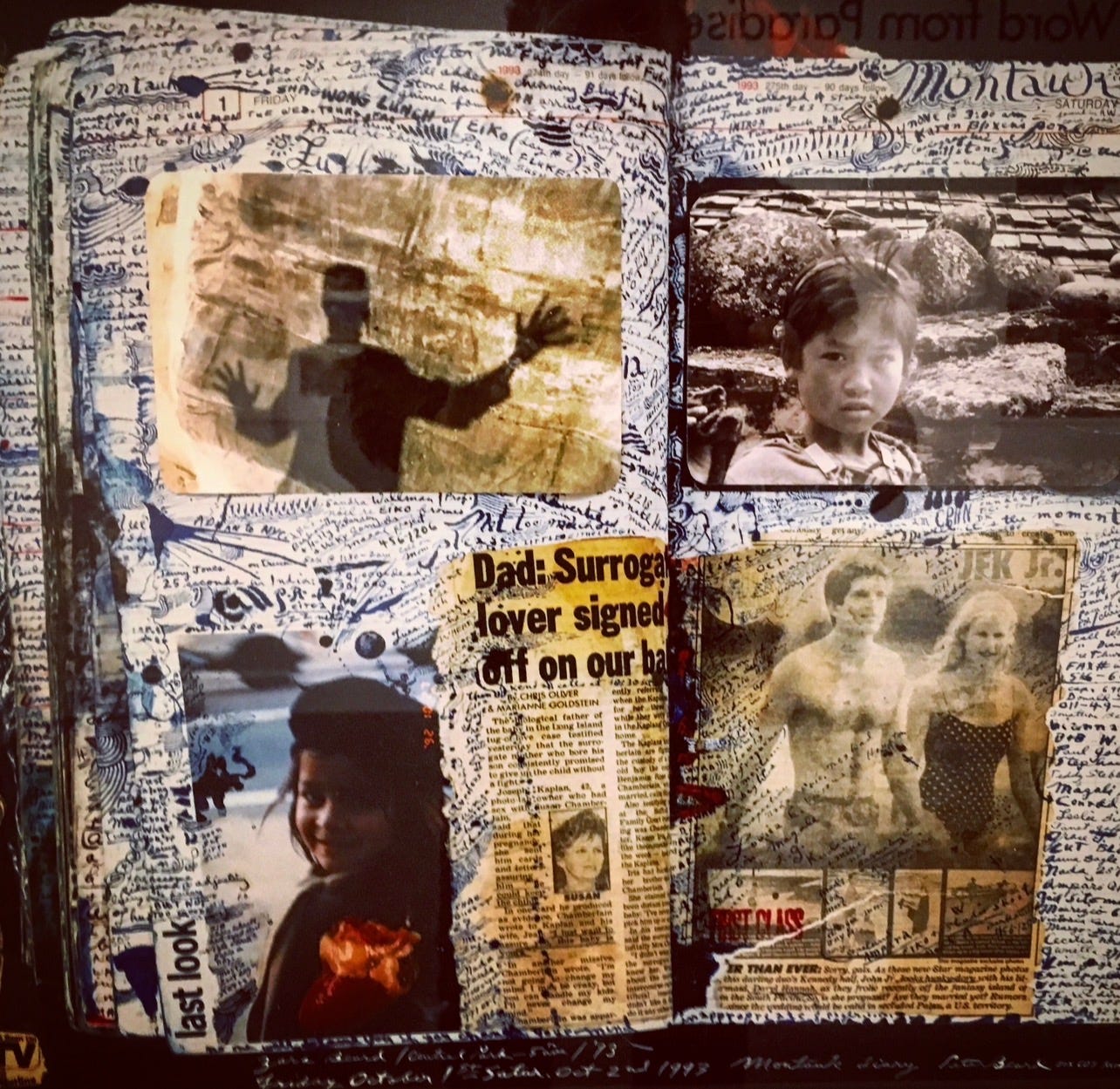
A journal is my primary creative tool when making any film, but especially at the beginning stage. There’s no one right way to do it, but here’s my way.
I actually keep two running journals. One is plain, lined and spiral bound. I open it unfailingly first thing every morning, preferably in a comfy chair and accompanied by a delicious cuppa hot java. I’ll write at least one page as fast as I can about anything that pops into my head without censoring myself. It’s more to loosen up the cobwebs in my brain than anything.3
The other journal is lightweight enough for me to carry around everywhere. It’s dedicated solely to the film project at hand, and to note any and all thoughts and insights, whatever the time and wherever I happen to be. I prefer a gorgeous, museum-quality journal, as it makes me feel like my ideas are worthy and valuable. I’ll re-read it periodically over the months (and, ugh,, years), marking the best notes in colored pen for easy reference. Occasionally, I’ll come across evocative images that inspire me, and in they’ll go, too.
What’s the story?
In my journal, the main questions I keep asking myself over and over is: What’s the story? And then, what’s the real story underneath the obvious one? And, beyond that, what’s the really real story? The story I might not have realized I was telling, or might have been terrified of telling.
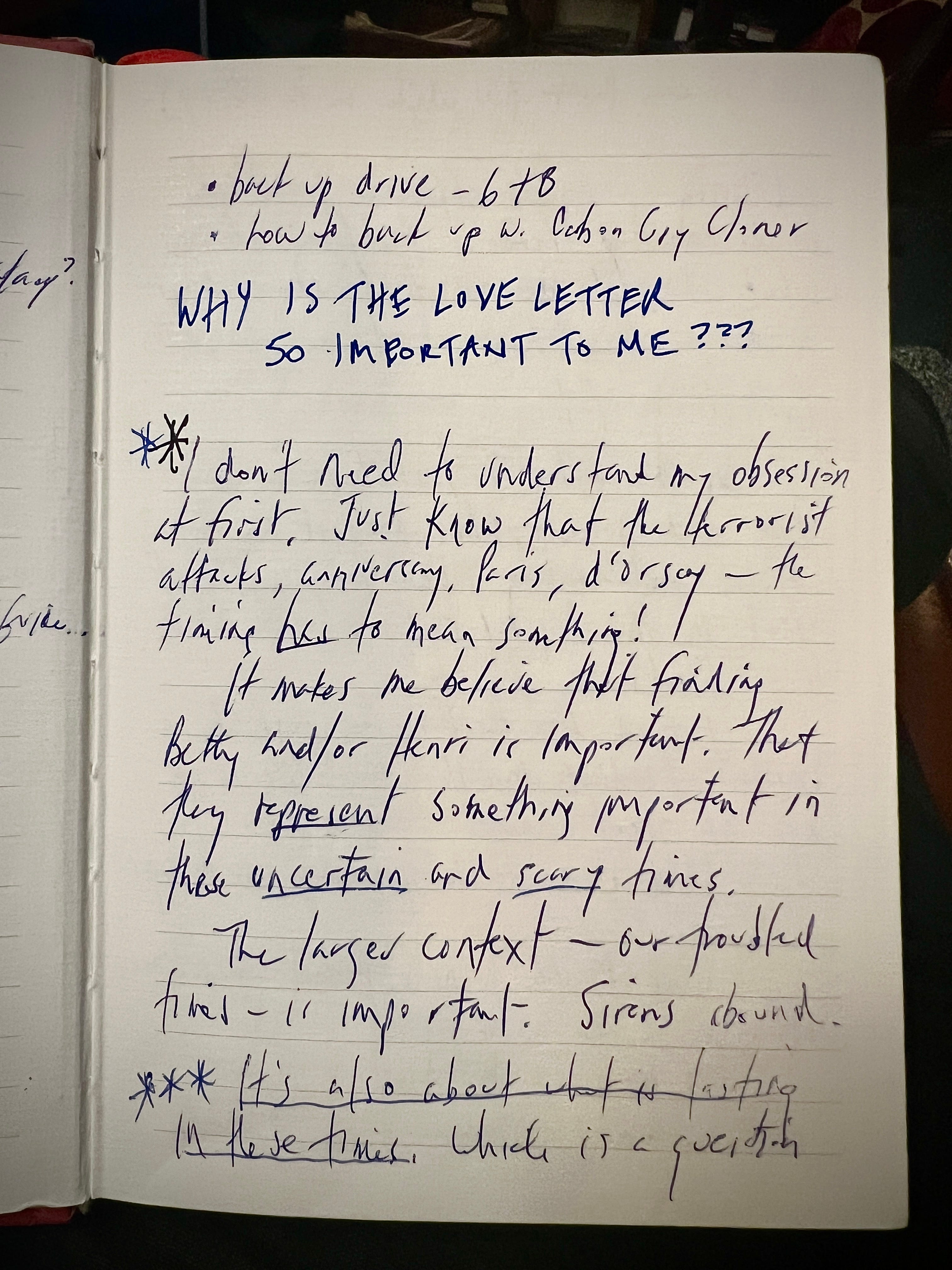
With 51 Birch Street, it was acknowledging that it was more than just a story about my parents’ marriage, it was about the unexpected emotions surrounding the loss of the house I grew up in. And on a deeper thematic level, the meaning of home. I thought I was fine with my father selling the family house and moving to Florida with his new wife (albeit, alarmingly soon after my mother’s death). But when I arrived with camera in hand, thinking it was for the last time, I saw all the familiar rooms being emptied out and was gutted. I hadn’t even thought of making a film until then, and once I realized I was doing just that my journal helped me process my thoughts. Among other things, I made sure to get as many shots of the house as I could before they left, and then returned at different times of the year to shoot exteriors. Ultimately, it was instrumental in changing the film’s title to our actual street address.
With The Kids Grow Up, it took a lot of self-reflection to realize it wasn’t just a longitudinal story about my daughter growing up and leaving home for college. It was also about my fear of the looming empty nest, and what it meant for my marriage. And digging even deeper, about my anxiety over growing old. Understanding that led to much of the films’ humor, its bittersweet ending and the plural in the title.
The Kids Grow Up trailer
What’s my role in the film?
I find it helpful to think of myself as a character in a fiction film. What do I want, and what obstacles are in the way of my getting it? What are the stakes, and what can be done to heighten them?
In 51 Birch Street, my role was to be the defender of my beloved late mother, and to get the goods on my father and that new wife of his, Kitty, his former secretary from 40 years before. Had he been cheating on my mom with her all these years?
Understanding this, I knew not to ask the question directly of him until the last possible moment in the film. If he’d said no it would have been end of story, and a lot of humor came from my asking every which way but directly. In real life, I didn’t really care so much one way or the other, but that didn’t matter. It was the Hitchcock’s MacGuffin that drove much of the plot. The truth was far more complicated, as viewers would discover.
What are the story’s bigger themes?
As riveting as it might be, it’s not enough just to tell the story. It’s important to find the larger context, the bigger picture. In other words, the story’s themes.
What do you want to say with your film? What do you want the audience to take away from seeing it? Unless you’re able to communicate this to your editor, she’ll be hard-pressed to know what to be on the lookout for when she views and selects your footage.
Often your themes can be reduced to a tagline.
51 Birch Street - Do you ever really know your parents?
The Kids Grow Up - Letting go is hard to do.
112 Weddings - Marriage is complicated.
At this point, you might be wondering why I’m placing so much emphasis on story and theme. To me, it boils down to this. While other forms of documentary (historical, social issue, biography, experimental) aren’t necessarily dependent on story, personal docs are totally story and character-driven. Those without a truly compelling story or relatable characters can easily be insufferable and squirm-inducing, and make the filmmaker wish they were never born. The larger themes are what make your story universal enough that it will resonate with audiences all over the world.
Am I shooting it myself?
Wowza, this could be it’s own Substack post, and (note to self) it likely will be. I’ve shot most of my films as a one-man band, including all of my personal docs, and there’s so much I have to say on the subject.
Personally, I prefer first-person docs that are shot by the filmmaker, at least if they know what they’re doing. I feel closer to the storyteller when I’m able to see the world, literally, through their eyes. I especially like it when the people they’re filming look right into the camera lens and address the filmmaker directly.
If you’re able to do the shooting yourself it obviously has its advantages in terms of intimacy, flexility and affordability. I feel every additional crew member, including a sound person, doubles the self-consciousness of the participants, especially if they’re family. And those pesky crew peeps want to be paid, the nerve!
I always make sure to mic myself, either with a wireless lav or by turning a camera mounted external mic at an angle that picks my voice up, as well. It’s especially important to be mic’d for interviews. One of the great advantages of acknowledging your own presence in the film is that your off-camera questions and interactions can be fully utilized, including the silences. A long pause often speaks more eloquently than any words.
from 112 Weddings (:15)
To what extent am I in it?
If you have a DP shooting it, other questions come to the fore. Will you be on camera occasionally or a lot? If you’re off camera completely how is your presence felt? Might it be through narration? If so, how much? Might you use title cards instead of narration? When doing interviews, will the camera widen out at times to see over your shoulder? Might you want a second camera to film you, as well?
If you only decide during the editing that you need to be in the film, how do you do so without having footage already shot of you? Perhaps it’s through use of archival material. In that case, how much access to old photo albums, home movies, vhs tapes and other paraphernalia do you have? It doesn’t have to be just visual material, either. Audio tapes and phone recordings work well under the right circumstances.
As you can see, there are sooo many questions to be asking of yourself (this is where your journal is invaluable). And of your DP, if you have one. Likewise, with your editor. Even if I’m not ready to hire them yet, I like to have informal coffee meetings with potential collaborators at an early stage and brainstorm.
Most of all, watch other personal docs. I highly recommend you start with those of the stellar filmmakers I interviewed here on my Substack — Sarah Polley, Alan Berliner, Caveh Zahedi, Geeta and Ravi Patel, Ross McElwee and Robb Moss. Or, heck, maybe one of mine.
Finally, don’t overlook an experienced story consultant. Did I happen to mention I do that all the time, too?
Like nosing through 40 years of his mother’s diaries.
NOTE TO SELF: Save some of this for your paid subscribers, you idiot!
For many years I practiced Julia Cameron’s legendary “morning pages” religiously, which urges you to write 3 pages in this manner. I highly recommend her book The Artist’s Way, but I find 1 to 2 pages suits me just fine these days.
I love hearing about your discovery process with 51 birch street and the kids grow up. I haven't seen 112 weddings yet but I plan to see it soon. I will likely be reaching out to you soon for some consultation on a pair of projects I'm working on. I could use your help! Thanks for letting us know you are available for that.
It's funny you mention Julia Cameron and The Artist's Way. I've been on again/off again doing those "Morning Pages" for years, but yeah, only one page, not three. Or for ten minutes. Whichever comes first. Finally, I can admit that! I was keeping that a secret. More evidence of your power as a personal storyteller/truthteller, capable of bringing hidden truths to light....