
Going Way Back and Experiencing the Deja
When it comes to indie film distribution, the more things change, what goes around comes around and history repeats itself. Oh, and where there's a will there's a way (except when there isn't).

When you’ve been making films for as long as I have, time gets a bit blurry. One teeny weeny thing — in this case a passing mention in Filmmaker Magazine — kicks off a long-forgotten memory, I click the attributed link, and, yikes, another link, and I’m suddenly plunging down a rabbit hole, bouncing back and forth between the decades.
And now I’m writing all about it here, you lucky duckies.
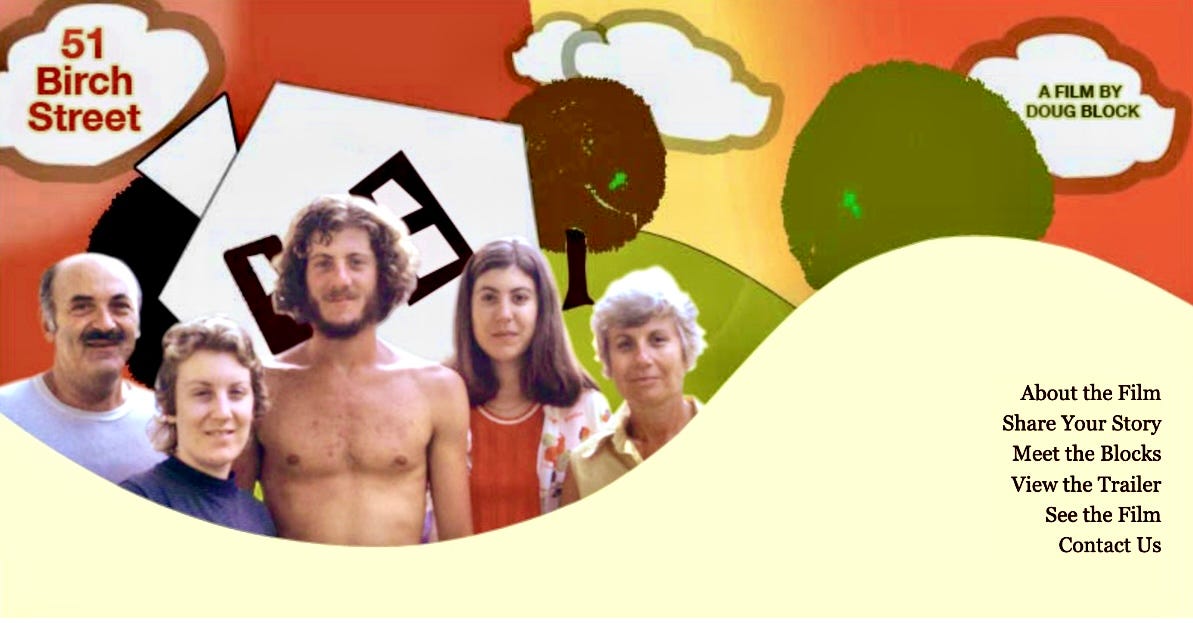
This is gonna be a whopping long post, so bear with me. It may seem to be focused on film distribution (and, specifically, various accounts about how my 2006 personal doc 51 Birch Street innovatively made its way out into the world) but it actually has bigger things on its mind. To me, it’s more about the circular nature of time and memory, and how the more things change in this crazy industry the more they stay the same. If you’re looking for one main takeaway, you can do worse than the very last sentence of this piece, so hang in there.
The other day I was diligently focused on my work when I decided it was urgent to check my email for the hundredth time that morning. The weekly Filmmaker newsletter caught my eye and, while I often don’t take the time to read it, I always like seeing what editor-in-chief Scott Macaulay has to say in his Editor’s Letter, especially now that he’s leaving after an impressive 33-year stint.
He mostly reflected on how so many of the so-called cutting-edge trends in the film industry these days give him a nagging feeling of deja vu.
“I experience that deja often these days as filmmaking conversations and topics recur again and again. The “filmmaker as brand” discussion was, in fact, posed by Jon Reiss here in 2010. He wrote, “I think that all filmmakers, in fact all creative artists, have the opportunity to be both. For many filmmakers, the sooner they realize this potential, the happier they will be.” And the Substack-driven term non-Dē is really not much different, I think, than the various formulations of “true indie”—films made completely outside of industry structures—that have been articulated here and elsewhere for decades.
Interestingly, back in the late aughts and early ‘10s, the “true indie” moniker was adapted into Truly Indie, the name of a company (now defunct, of course) launched by Shark Tank’s Mark Cuban and producer Todd Wagner, which turned the term into a business model. According to Wikipedia, “The filmmaker pays an upfront fee that covers all distribution costs—marketing, advertising, and publicity. Securing a one-week run in at least five markets, the filmmaker keeps all of box office receipts and retains all rights to their film.” So, a service deal, except the folks behind Truly Indie owned Landmark Theaters, ensuring premium venues. To see the enthusiasm such announcements garnered back in the day, read this web archived 2006 interview by Doug Block about his decision to use the service.”
I tend not to look back on my past work — like a shark, I keep moving forward. But Scott’s post started to bring back long-dormant memories. I could feel my index finger twitching. I had so much to do, but how could I resist clicking the link and seeing what I had to say way back then? Suddenly my head was spinning, the calendar years were flipping backwards, and I was plunged back in time to this epic web post by Sujewa Ekanayake, a prolific blogger, a “maker of delightful movies,” and quite the excitable wordsmith.
November 12, 2006
Doug Block, 51 Birch Street, “Truly Indie: The Interview”
But First, A Long Introduction: 2006 = Year One of the New Self-Distribution Movement (or go on you sexy hard working self-distributin’ filmmakers!)
I am very happy with how some of my fellow indie filmmakers & would be indie filmmakers & indie film fans are tackling “the distribution problem” this year. 2006 is a record year for self-distribution/partial self-distribution & experimental distribution projects in the US independent film scene (i know ‘cause i’ve been keeping track. this year, more than any other year in history, has seen more high quality ultra-low budget indies/”real indies”, fiction & doc features, getting in front of an audience -outside of festivals -due to distribution efforts by the filmmakers. will have an year end report on this phenomenon in late Dec. or early Jan.).A couple of Saturday’s ago I went to see Mutual Appreciation in DC & spoke briefly with indie filmmaker & self-distributor Andrew Bujalski. And then last Saturday I screened my film Date Number One in DC & then after all the work was done I went to see Borat. It was interesting being at Borat because the several hundred people there, for the most part, probably did not know - in painful detail - about ALL THE WORK that happened between completion of the film and them seeing it in a comfortable stadium seating containing gigantic screen mall movie theater.
Take that amount of work and multiply that by 100 (due to lack of: studio level funding, experience, a track record & contacts, & the resulting power to influence) & add the stress of not having any extra money or not enough money and not enough helpers and not enough sleep and then you might have a good understanding of the kind of work challenge that Bujalski & Doug Block & other self-distributing filmmakers are confronting this year as they take their movies to audiences in various cities.
One of this year’s specially noteworthy cases of self-distribution is Doug Block’s documentary about the mysteries of his parent’s marriage: 51 Birch Street, and the service deal route that is now taking the film before theatrical audiences.
Block & business partners chose the Landmark Theaters affiliated distributor-for-hire service Truly Indie to assist them in getting their award winning & well reviewed movie out to the theaters. Here is an e-mail interview, conducted within the last couple of weeks, with Mr. Block regarding his bold & apparently very-rewarding-on-certain-levels self-distribution project (and yes, I do bring up the Caveh Zahedi/Sex Addict/Mark Cuban issue from earlier this year, can’t really leave that out of a Landmark related indie film post can i?, well, at least not this year :)
Interview with Doug Block regarding distributing 51 Birch Street with Truly Indie’s help
Sujewa: Can you explain how Truly Indie works? As far as I understand it is a distributor-for-hire service: a flat fee is paid to Landmark’s Truly Indie for getting your film screened at a certain number of theaters & you get to keep the $s earned from ticket sales, right?
Doug: Once you get chosen and agree to go with them you’re given a list of Truly Indie cities (about 20), the local Landmark theater it will show in that city, the seat numbers, ticket prices, and an exact fee it will cost for that city down to the dollar. The fee includes a publicist in each city (overseen by Melissa Raddatz, the Landmark Director of Publicity), 2 ads in the local paper of record, and in return you keep 100% of the box office. Most important of all, you keep all other rights to your film.
Sujewa: What made you decide to purchase Truly Indie’s services, instead of attempting to book the film with various theaters by yourself (or did you try to do that first?)?
Doug: We didn’t want to do all the work ourselves. Truly Indie seemed like a good blend of DIY and going with a traditional distributor. And we were able to raise money from investors to support a theatrical release, our exec producers Priddy Brothers Entertainment. They were very intrigued by the Truly Indie model.
Sujewa: How was the 51 Birch Street opening in NYC? The film certainly received some excellent press coverage. And was Truly Indie helpful in securing that coverage or did you have to do most of the press work?
Doug: The NYC opening was fantastic. Helped greatly, of course, by a Sunday NY Times feature and a rave of raves from A.O. Scott in the Times. We got the Sunday piece ourselves, through a combination of knowing John Anderson from way back and serendipity. He happened to be a juror at the Miami FF where we had our U.S. premiere, so he got to see it early with a full house and my father and his wife doing a Q&A; with me. The press has really built on itself, success builds that way, but a good deal of the early press was blogs, which we mostly got ourselves. But Truly Indie helped out a good deal and Melissa Raddatz somehow managed to get A.O. Scott to do the Times review, which was critical. We felt of all the Times critics he would “get” the film.
Sujewa: I was at a Mutual Appreciation Q & A with Andrew Bujalski in DC last night & he said he never expected to become a film distributor but now he finds himself as one. Film distribution certainly comes with a serious amount of challenges. How do you feel about being a distributor (even though you have a very useful partner in Truly Indie)?
Doug: Yes, it’s been a very good working relationship with Truly Indie. They’re very involved and they welcome our collaboration. A total team effort, which we wouldn’t have with a larger distributor probably. But if you go with Truly Indie, or any service deal distributor, or even any small distributor, expect to do a LOT of the work yourself. I’ve been very lucky to have a great producing partner, Lori Cheatle, who’s shared the load with me, and we have fun working together. But distribution, in general, is just a huge amount of work, and the marketing and outreach is never-ending. We worked really hard making the film and it hasn’t eased up a bit since we finished.
Sujewa: What, if any, is the down side, as far as you can tell now, about working with Truly Indie?
Doug: Given how well the film was received, both critically and with audiences, it would have been nice to have a distributor that could have kept the momentum going with bigger ads. But that’s hardly a downside since we knew that’s not what Truly Indie does going in. The whole point of our theatrical was to see if we could at the very least raise the awareness of the film both with the public at large and within the industry. Because it’s all about selling the DVDs down the line. And you need to get it on people’s radar somehow for the DVD to be in demand. There’s a ton of films out there and it’s hard to break through the clutter. And I think Truly Indie has definitely helped us accomplish that. So, sorry, can’t give you too much down side. Even having to raise the money to pay the fees has been a blessing in disguise. We now have a partnership with the Priddy Brothers that gives us access to greater resources and will carry forward into future projects.
Sujewa: In my experience theatrical screenings/distribution takes a lot of work. Are you working on 51 Birch Street distribution full time these days or are you able to maintain your regular job & also do the work required by distribution?
Doug: Getting your film distributed is like having 3 full-time jobs at the same time, none of which pay.1 I’ve managed to stay afloat with occasional freelance work, consulting, some wedding videos (which, yes, I still shoot), and honorariums. But it’s been a sucky year income-wise. Hopefully, it’ll pay off next year and for years to come. I believe that the laws of compensation aren’t necessarily direct. They’re circuitous.
Sujewa: Were you ever wary of working with Landmark/Truly Indie because of owner Mark Cuban’s strange & counterproductive behavior with the I Am A Sex Addict release earlier this year (Cuban canceled the premiere of Sex Addict in a Landmark Theater a week prior to the event as a protest against Comcast’s dealings with one of his businesses, Comcast being the cable VOD partner of IFC Films for Sex Addict, if I recall correctly)?
Doug: No, I like Mark Cuban. What happened with Caveh was unfortunate, but I like that Cuban’s bold and thinks outside the box. Everyone knows the traditional distribution model is broken, but he’s one of the few trying to do something about it. I like that he has his own blog and answers his own email. I have a lot of respect for what he’s done with 2929 and integrating the companies under its umbrella (Truly Indie, HDNet, Magnolia and Landmark Theatres). It may not be visionary but it’s very smart, and from what I’ve seen it works very well. Our emails to the Truly Indie core group often get cc’d to everyone, including Cuban. And I love that he has the attention of the entire industry. When the press release for 51 Birch Street went out, it was covered widely because we were doing the deal with Mark Cuban’s Truly Indie, which wouldn’t have happened with other distributors, believe me.
[2025 NOTE: I thought of not including this question about Cuban, but he’s representative of our collective fantasy that some benevolent billionaire who loves cinema will come along with a genius new model for financing, production or distribution and rescue the indie film sector. It was a pipe dream then and it’s a pipe dream now. The super rich might dip their toe in the waters, but they care far more about making money than making movies and soon skedaddle. But, hey, Mark Cuban, if you’re reading this, I have a new project that could use an Exec Producer.]
Sujewa: If the initial handful of cities respond well to 51 Birch’s theatrical, do you & Truly Indie have plans to expand to more cities or is it on to DVD & cable after the currently scheduled theatrical engagements?
Doug: We definitely will be expanding to more cities, both with Truly Indie’s help and independently. We’ve already booked a dozen cities and have more inquiries from theaters and semi-theatrical venues coming all the time. We’ll be focusing mainly on calendar houses where the cost to us is pretty much non-existent.
Sujewa: All business/financial & work load concerns aside, does it feel awesome to share the film about your parents with audiences in movie theaters?
Doug: Of course! I became a filmmaker because I loved the experience of seeing movies in theaters with audiences. To be sharing my own work in theaters AND to have it be with a personal film AND have it so spectacularly well received... well, it doesn’t get any better.
Sujewa 11/19 update:
Go here for a few more important points about Truly Indie, at Doug’s follow up blog post to this interview.
Well, well, well… a total acid flashback to a hybrid model of distribution that we’re employing right now, two decades later, with another personal doc I’m producing, My Omaha. Like with Truly Indie, it’s mainly a DIY effort in that we’re bypassing a traditional distributor that would take all the rights, and working with a service deal distributor (Jim Browne, Argot Pictures), an impact producing team (Carrot Impact) and a forward thinking theatrical initiative (Annie Roney, IRL Movie Club) to get the film out there. In return, we retain all rights and keep all income (minus the theaters’ shares).
Anyhoo, now my resistance is kaput. I simply must click on Sujewa’s link to see what “important point” I had to say on my own blog. Not my more renowned blog The D-Word, mind you, the one I kept up for four years (1996-2000) before, thankfully, turning it into the worldwide virtual community for doc professionals it still is today. Nope, history repeated itself and I did a new one for another four years with the clever name of Around The Block: Doug Block’s Doc Blog (2006-2010).2 Not to mention, a memorable tagline that totally holds up (“A life of glamour and riches, as only a documentary filmmaker could live it…”).
The only problem is that Typepad, the web platform I’ve been paying for all these years just to archive the blog, recently went out of business. And I somehow bungled the blog backup process before they did, so I couldn’t access it any longer.
Luckily, I remembered the lifesaving magic of The Wayback Machine, lit a candle, said a silent prayer and, hallelujah, there it was! And, just as I remembered it, in the same web formatting with links intact. I almost got sucked down yet another rabbit hole reading a bunch of fun posts like this one!
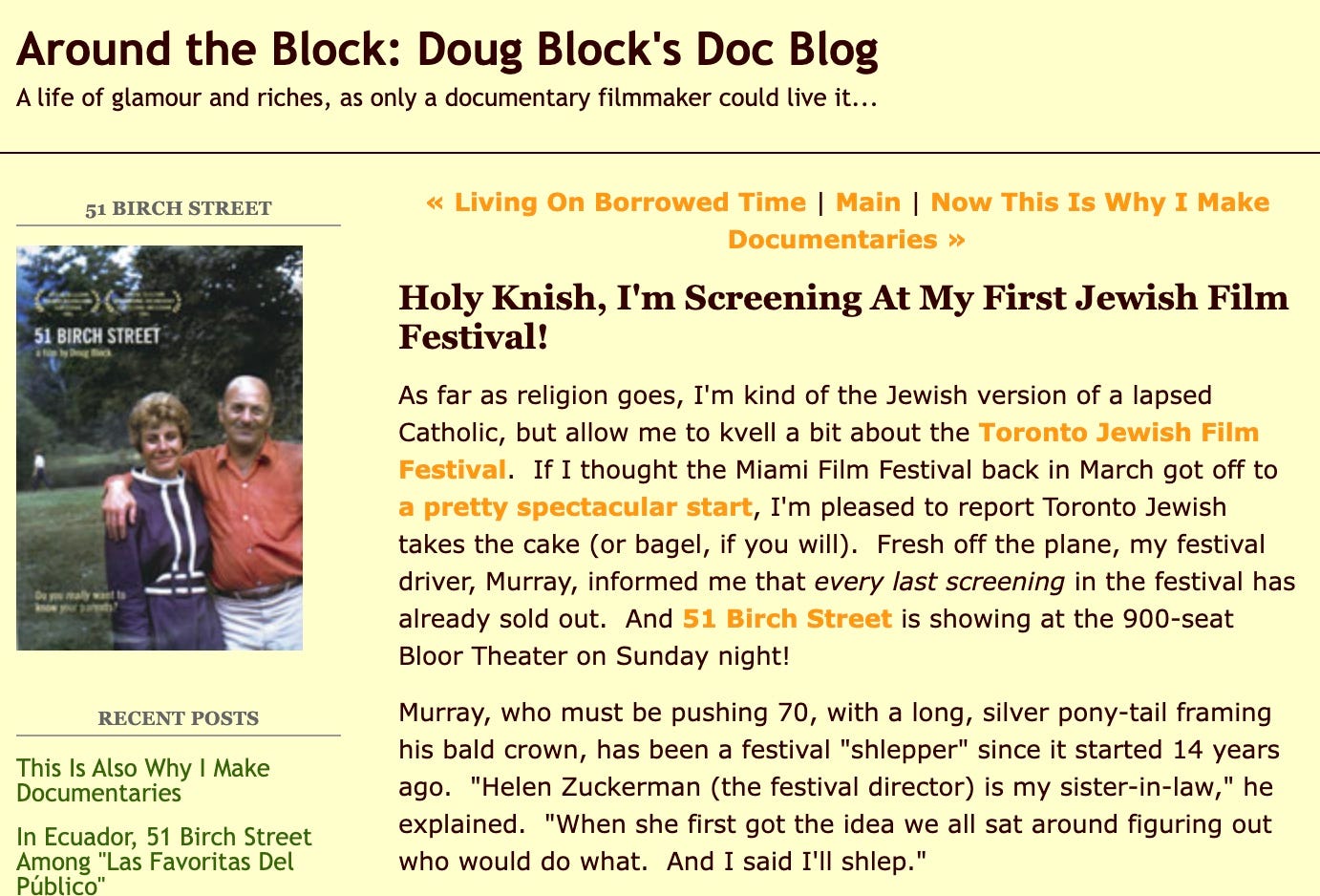
For a short moment I was transported back to 2006, slaving away into the wee hours over long, carefully crafted blog posts for a readership of maybe dozens (I had no way of really knowing). I had put my heart and soul into them, so it was hard to tear myself away and check on my Truly Indie postscript. But with remarkable self-discipline, I soon managed to,3 and here’s what I had to say.
November 16, 2006
A Few More Notes On Truly Indie
It’s pretty much the dictionary definition of laziness that I’ve allowed my own blog to be scooped by granting an in-depth interview about Truly Indie to Sujewa Ekanayake’s DIY Filmmaker blog. After all, 51 Birch Street is entering it’s “5th BIG WEEK!” in theaters (as our microscopic weekly NY Times ad will scream out tomorrow), so it’s not like I haven’t had the opportunity to comment.
But it’s so much easier to talk about this stuff in an interview format and I have a lot of respect for Sujewa’s social networking skills. Sure enough, the email interview was online practically the moment I clicked the “send” button and has been highlighted by such widely-read blogs as GreenCine Daily and Filmmaker Magazine. Impressive, Sujewa.
Scott Macaulay at Filmmaker was a tad disappointed that I didn’t do more hardcore number crunching, but there’s a reason for that. When we signed the deal, Truly Indie asked me not to (largely because they’re considering raising their fees at some point). Personally, I think that’s a bit silly, since if filmmakers knew how relatively low the cost is, they’d be flocking to Truly Indie’s door. But TI’s Kelly Sanders is on the record as saying (at our Toronto Film Festival panel) that you could do a 5-city release for as little as $35,000. And in the same post (hint: see #7), I cunningly hinted at what our fees are for our initial 5 cities, which included NY, LA, SF, Chicago and Minneapolis.
Like I said, the interview was pretty comprehensive, but I do want to follow up with a few points I failed to mention.
1. There are usually a lot of competing interests in any theatrical distribution effort. Given that we had already pre-sold 51 Birch Street to HBO/Cinemax, and given that I hope to have a long and healthy relationship with them, it was important to go with a distributor that wouldn’t overshadow or play down HBO’s role. Truly Indie has been more than happy to give HBO its props.
2. Working with Truly Indie feels like a real partnership. Kelly Sanders, who oversees TI, has been extremely accessible, returns phone calls and emails promptly, keeps us in the loop on all decisions, and couldn’t be more pleasant and enthusiastic. In the months we’ve worked together, there honestly hasn’t been one adversarial moment.
3. Likewise, Laura Louden and Jasmine La Rue, who do the ads for Landmark Theatres (and do a great job, btw), are constantly asking me and Lori for our input. Literally nothing goes out without our approval.
4. Finally, you can be smart, you can be strategic, you can spend a ton or be downright cheap, but if you don’t have a film people want to see you aren’t gonnna get very far. Having had some experience with TI, I can highly recommend them as a legit distribution alternative, but they’re no miracle worker. Relatively speaking, it’s a small scale operation and, like with any distributor, you should enter any dealings with them with your eyes wide open and your feet firmly planted on planet earth.
The calendars have flipped forward in time, I’m back in the present (it’s 2025, right?), and this head-spinning trip down memory lane has been a lot to take in, even for me. For indie filmmakers pondering the depressing state of film distribution these days, that bolded last sentence is certainly a key takeaway, isn’t it?
But for me, the real one is this: Plus ça change, plus c’est la même chose.4
I love hearing your feedback, and try my best to respond to all of it. So don’t hesitate for a nanosecond to:
More like 4 full time jobs nowadays (5, if you include having a Substack)
Needless to say, history is repeating itself once more again with this Substack!
Ok, l’ll admit, a half-hour an hour later.
If you don’t know that one, get thee to Google Translate (like I did).
Love the line “I believe that the laws of compensation aren’t necessarily direct. They’re circuitous.” So eloquently put.
It is very Buddhist in philosophy and similar to what Deepak Chopra writes in his Seven Spiritual Laws of Success. But in the moment when wearing lots of different hats and hustling for gigs, it can be hard to keep the faith. Thank you for reminding us all to persevere.