
Getting Personal with Michel Gondry
The visionary filmmaker discusses the difference between filming with documentary subjects and actors, the need to be ruthless at times and the obligation not to be boring.

It was March of 2010, and I was at some industry event — I forget which one, they all begin to blur — chatting with Eugene Hernandez. Eug was Editor-in-Chief of IndieWire at the time. Now he’s the Director of the Sundance Film Festival and goes by Mr. Hernandez, sir.1
He thought I’d like to know that he’d just moderated a SXSW panel with Michel Gondry, who was there with a terrific personal doc about his family called The Thorn in the Heart. And then he floored me. When he asked Michel what films most influenced him he not only mentioned 51 Birch Street but said it was the best film he'd seen in a long time.
Eug suggested I reach out to Michel directly. But before I could figure out how to do that, I got word from his distributor, Oscilloscope, that Michel was coming to town shortly for the NYC release of The Thorn. Might I want to go to opening night and say hello?
Um, yeah.
Let’s just say, it’s not every day that a visionary director whose work you greatly admire even knows of your existence, much less compliments you, and goes out of his way to want to meet you.
I was also curious to see how such a wildly inventive film director (The Eternal Sunshine of the Spotless Mind, for one, along with a string of brilliant music videos) would handle an intimate, first-person story about his family.
The Thorn in the Heart focuses on Michel’s aunt Suzette, and her often difficult relationship with her bisexual son Jean-Yves. Watching it on the big screen, I was struck by the humility and simplicity of Michel’s approach. As well as the loving grace in which he handled one of the most difficult challenges facing a documentary filmmaker. Namely, that his lead character wasn’t a terribly charismatic or sympathetic figure for much of the movie.
The large Village East theater was packed for the premiere, and the showing was well received, but when Michel took the stage afterwards for the Q&A he was steaming mad. He proceeded to lash out at a few critics he felt had reviewed the film unfairly, then asked everyone who didn’t like the film to stand up.
Whoa, that’s ballsy!, I remember thinking. When about a quarter of the audience took him up on the dare there was a tense moment of silence and then laughter. Michel thanked them for their honesty.
By the time we met afterwards Michel had calmed down. He even chuckled when reciting the takeaway of “some asshole online critic.”
“Anyone can make a crappy home movie, but it takes an especially self-important one to think anyone other than their own family wants to watch it.”
“Oh, zing, good one!” I replied, wondering how I could top it. I recalled a charming online comment about The Kids Grow Up (my sequel to 51 Birch Street, which was playing the festival circuit) by someone who clearly hadn’t seen the film. She wrote I should be locked up and have my balls cut off for doing nothing but filming my daughter every moment of her life. We shared a good laugh.
Making personal docs about one’s family takes a very thick skin, we agreed.
The brief encounter carried over to an email correspondence that I treasured. Many of Michel’s were accompanied by photos, like this one shortly after I sent him a link to The Kids Grow Up.
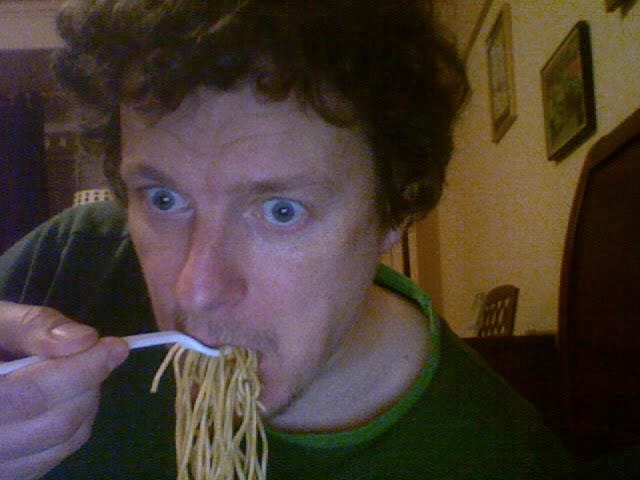
His response to the film couldn’t have been kinder. Or more Gondry-like.
“Your movies are more entertaining to me than any thinkable fiction.
Seeing part of your previous films in it (like your parent's 50 years anniversary) gives a strange feeling to watch a memory that half belongs to me. This is very interesting.
Your daughter is so beautiful and smart and sincere. I guess growing up with the introspective camera-dad must have had some influence on her.
It’s funny, I didn’t shoot with my son so much, but for my father’s day a few years ago he did a drawing of me filming him and he is screaming at me: “Dad I don’t have any private life!”Do you think you will hold a camera when you die? Sorry, this is a terrible question.
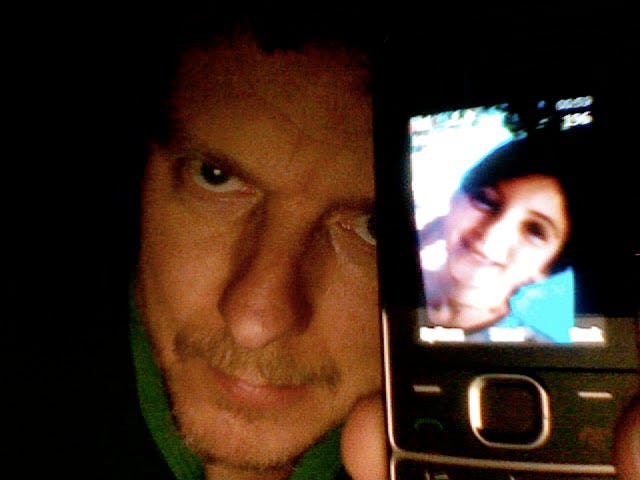
When The Kid Grow Up had its own theatrical opening night in LA, Michel kindly agreed to moderate the Q&A. I take it as a tribute to him that when the projection lamp blew five minutes from the film’s ending and took ten excruciating minutes to fix, not a soul in the packed audience left. Unless they were simply lying in wait to cut my balls off.
A few years later, when it came time to select filmmakers to interview for Getting Personal, my doc about personal doc filmmaking, Michel immediately came to mind. I wanted a mix of filmmakers like Ross McElwee, Nina Davenport, Alan Berliner and Caveh Zahedi, who were personal doc lifers, along with those like Sarah Polley and Michel who were confirmed one-and-done’ers, and couldn’t wait to get back to the world of fiction.
Happily, a whirlwind press tour for his latest movie, Microbe & Gasoline, took Michel through New York City for a few days. He was clearly exhausted, but generously squeezed in some time to talk with me at his downtown hotel room.
With the help of DP/editor Jessie Adler2 I’ve pulled some highlights of the interview, focusing mainly on the particular challenges of filming with family members, especially reluctant ones.
For those who’d rather read it than watch it, I’m including the transcript (very lightly edited for clarity).
Interview highlights (16:52)
Michel: When you have a camera and you engage yourself into a project that needs to be completed, there is nothing worse than to not finish what you start. So, yes, you feel an obligation to dig. It’s very stressful sometimes because you feel you dig and there is nothing coming out. And then you have sweat going down your head and you think, okay, I’m not shooting anything that’s gonna be interesting in any aspect. So you have to go in a different direction, try to find something and there is a huge suspense.
It’s a bit like when you do casting, and you have to interact with somebody that’s completely a stranger to you, and find a way to get from this person an element that will help you decide if he’s right or she’s right or wrong for the part. So you have to react really fast, because if you just say nothing then you have no element to make your judgment. So I find there is a parallel in both cases. You have to find a way to get things to happen, and it could be really challenging.
Doug: Yeah, you kind of really have to be ruthless in a way, don’t you? But the difference is they’re not actors, you know? You can hurt the feelings of an actor by pushing and prodding and challenging them, but you can’t deal with your family members that same way.
Michel: No, it’s true. I mean, some want to be in front of the camera, but those are not the most interesting people. But somebody who doesn’t really have any interest in being in front of the camera, they give themselves to you, so you don’t feel you have the right to manipulate them or torture them or dig in to them to find any kind of truth. It’s not like if they are going to see a shrink and ask to be digged into and reveal some truth. That’s something you decide for them, and it’s intrusive. But, again, if you want to do something that’s interesting, you have to go through that.
Doug: Any reservations about suddenly doing something so personal?
Michel: Well, in the beginning I was supposed to talk about my aunt Suzette as a school teacher, and her experience through the different schools. I think she went through eight schools, and sometimes with only four pupils because she was experiencing the desertion of small villages and communities. And she was generally the last teacher before the school was closed, and had to move to another town. So, it could be personal, but it was not the goal to dig into that more than to record her experience in life as a teacher.
Unfortunately, as much as she was funny when we would talk without the camera, when the camera was rolling she started to act more and more as a school teacher. She was not as funny, and she was a bit contrived. So I felt I was going nowhere, in a way.
But that’s not the reason why I shifted the story. I think what happened is we were trying to find pupils that she had had over the years, and there were very few we could find. They were gone, or they didn’t want to be shot, or whatever. And one of the pupils she had every year, every month, every day, was her son, Jean-Yves. Unfortunately for him, because I don’t think it’s healthy he had all the time his mother as a teacher.
So, we started to interview him and we had long takes. And after one long take he said — I mean I knew he was a bisexual but he never really spoke out about it, especially with his parents. So he started to talk about it. And then we could sort of confront it. When we did an interview with him and his mother we could see the tension. The cameraman, I remember, told me that he started with them close in the frame so we could shoot them close up [holds up hands in classic director’s frame, then widens them out], and then they always would go apart further and further, so he had to pull back the camera to keep them both in the frame. He told me, here you have your subjects, and it’s this relationship that seems very full of tension and catastrophy.
Doug: How did you feel when you realized, uh-oh, I’m getting into some — I mean, is there that split that you have between you as a family member wanting to be protective of these family members you love, and your job as a filmmaker to tell the most dramatic story you possibly can?
Michel: Yeah, it’s a big split between my feelings shooting my family and really being careful with their feelings, and my feelings as a filmmaker to make a good film, a film that will interest them. And I didn’t want to make a boring film because it would not have served her. Like, if I shoot a movie but my auntie on the movie is boring, that’s not good for her. Of course, it’s not good for me, either, it’s good for nobody, and it’s especially not good for her. So, I think, okay, it’s going to be more painful, but at least the movie would have more interest, and it’s better for her.
That was one of the reasons. Another reason is that when you’re behind a camera — and I’m sure you understand that — your boundaries are much, much further than when you don’t have the camera. I mean, I could really talk about the sordid, dirty details in their life, and ask questions I would never dare to ask in real life. But when you have the camera, it’s like a shell that protects you. And then you have the obligation to go further and not be satisfied with half of an answer.
So that’s our job. If we make a documentary, or even a feature film, you have to push it further. So, I had that in mind, the way I was hurting her. But, once again, it was more important that the film would be interesting. And eventually this process had a very good outcome because she understood what I was looking for a few years later and she thanked me for it. And the relation was fixed, or at least much, much better with her son.
Doug: Was it frustrating or liberating for you to not have a script while this was all going on?
Michel: Well, it’s scary, but it’s very educative, because basically you go there, you start to shoot, and nothing happens. And you feel like it’s a catastrophe. And then something happens, after days, maybe, where everything you shot was uninteresting.
And I experienced that when I did the documentary Block Party with Dave Chappelle. We went with him in Ohio, in his hometown, and he would give away golden tickets, like Willy Wonka, to come to the concert in Brooklyn. And I was following him with a camera with 16 millimeter rolls, which shot 10 minutes. And nothing was happening, and we were wasting film, and nothing, nothing, nothing, it’s just boring. And then all of a sudden, he met this marching band from a school, then talked to them about the concert, maybe they would come to the concert, everybody’s excited, they knew a song from Kanye West, and it’s pure magic. So all this tension that built up, with shooting nothing happening, to something really great, and that you could never imagine shooting for a movie. I mean, sometimes you have element, moment like that, but most of the time, no. So I think that that’s a price to pay to get something special, all this time you spent of film.
Doug: Are you a fan of personal documentaries in general?
Michel: (smiling) Ahh, yeah. I mean your documentaries are personal. I’m a fan of them.
Doug: Thank you. (laughs) I wasn’t fishing.
Michel: No, I mean, it’s the first example that came to me. (pauses) Yeah, I think so because you need to get some humor. Because there is a closeness there, even though you look at them through the camera. So you can’t take yourself so seriously. There is a layer of humor and intimacy that doesn’t exist when you do something that’s not so personal, and I think it’s touching. I mean you enter into the very heart of the relationship in a family that’s — I mean, maybe it’s voyeurism, but I think it’s stronger than most fiction you can think of. In fact, I have a very hard time watching fiction. I watch mostly documentaries now
Doug: Because you just don’t find them authentic enough?
Michel: Yeah, I mean in a documentary you watch something that really happened, and in a movie you know you’re watching something that’s been calculated, more or less successfully. And some movies are greater, but I think it’s more captivating to watch something that’s real. I mean, it’s silly but I really like to see the footage from the past in personal documentaries. And I don’t know how they do it because they always find images to illustrate what’s going on and you get sent back to a past that you may have experienced but from the outside. And then you see the image from the inside and so you realize, oh, that was that was what was going on at this moment. I just like this feeling.
Doug: If somebody came up to you and said, Michel, I’m making this personal documentary about my family, it’s such an amazing situation and they came to you looking for advice, what would you tell them?
Michel: For each scene or situation or question, give time to the subject to forget about the camera. It’s really a big machine and it’s very hard for us to forget about it, but for people who go in front of it that really affects their behavior. So you have to really spend time for you to become invisible.
And something else that’s very important in my opinion is to not know what you’re looking for. And, in fact, in science that’s actually a principle. Most of discovery has been done as a side effect to somebody was looking for some technology, and on the way this person discovered another thing that became what changed the world. Like the guy who invented the ship, he was looking for something else. So that works with documentaries, as well. You go there and you have to be open to changing your subject. But that’s just my opinion, because some other director might want to keep the direction, like a boat of their story.
Doug: Have you ever experienced a creative block? Or a loss of nerve?
Michel: Yeah, there are a lot of times. First, when you finish your shooting and you do the first rough cut, it’s a horrible feeling. It’s rather a disaster. Then when the film is finished, you have this really bad feeling about what you’re gonna do next. So, generally, I try to have another project ready for me to jump on when I finish one project. Like now I don’t have that, and I feel a little lost. Yes, I have creative blocks, a lot of them.
Doug: What do you do?
Michel: Sometimes I do a video, that helps me. I go to the countryside and I try to find ideas sitting next to a river. It’s not by watching movies, that doesn’t help me. I don’t have much of a solution. What do you do when you have a block, as your name is?
Doug: What do I do? I fret.
Michel: Fret?.
Doug: Yes.
Michel: What does fret mean?
Doug: Worry.
Michel: Ah. Yes, it’s true. (long pause) Time flies. We’re not getting any younger.
Doug: No. No we’re not.
Time flies, indeed, and I’m not in touch with Michel that much these days. His email quote is the first thing you’ll see on my website, so there’s that. But my gratitude to him goes far deeper.
Documentary filmmaking is a tough business. It’s unsustainable. Funding-wise, every time you set out to make one you have to reinvent the wheel. Distribution-wise, we’re required to build audiences from the get-go. And exhibition-wise, no matter how successful your film is there’s always some critic or viewer out there with a pair of scissors in their hands.
In other words, you can never rely on getting validation from the outside world. It has to develop over time from within, along with that thick skin.
When I think back on events that formed my own sense of validation as a filmmaker, three come immediately to mind.
Home Page being selected for the 1999 Sundance documentary competition.
51 Birch Street making the New York Times’ top ten film list of 2005.
Michel Gondry’s friendship.
When director Nick Beaulieu and I went to Hot Docs in 2024 to sniff around for possible My Omaha funding, we were excited to learn a documentary called Michel Gondry: Do It Yourself was world premiering there.3 We hoped Michel might show up for it, but the films’ producer, perhaps being protective, said he was filming something somewhere, he knew not what. Not Hollywood, though. After his experience with The Green Lantern, never that again. And never a personal doc again, either.
Just before publishing this post I went to Wikipedia to see what Michel has been up to lately. I learned his latest work Maya: Give Me a Title premiered at last year’s Berlin Film Festival. It’s described as such:
Michel Gondry, to keep in touch with his daughter Maya who lives overseas, creates animated stories from spontaneous script ideas suggested by her. With colored paper, scissors, Scotch tape, and a camera, he embarks on an inventive and collaborative project, drawing Maya into the world of fantastic tales.
So, in his own ingenious and inimitable way, I guess he’s continuing to make personal docs, after all.
Happily, he’s still one of the nicest and most beloved members in the movie industry.
Who’s been a godsend, helping out with all of the interviews. Thanks, Jessie!
It’s really good. If you can possibly see it, I highly recommend it.
Holy crap, you made 51 Birch Street?!? Forgive my ignorance, I've just recently met you through d-word and substack, and you have been so gracious to me. Now I'm starstruck! I will watch The Kids Grow Up ASAP. I loved this interview and the story of your meeting. I resonate with Michel's advice to be ready to change the topic as you shoot and his description of the catastrophe of the first assembly. I so appreciate all that you are sharing here in your new full time job. I will be a paid subscriber when you make the leap!
Man you've really been around the block! Sorry, had to do it