
Sundancing
As Sundance fast approaches, the last ever in Park City, I dust off a long-forgotten book I'm featured in, revisit my memories and offer some personal perspectives for filmmakers attending.

Having your first personal documentary world premiere at Sundance is surreal enough without being followed around by a top movie critic/ journalist for a book.
It’s been 25 years since I first read through the galleys of John Anderson’s kaleidoscopic account of the festival, Sundancing. I was one of three filmmakers he shadowed periodically throughout the 1999 edition (along with Gavin O’Connor and David Riker) where Home Page was picked for the documentary competition.
I wasn’t a Sundance virgin. I’d been there three times already, twice as a producer of films that were in competition. One, Silverlake Life: The View From Here, even won the 1993 Grand Jury Prize, as well as the Freedom of Expression Award, which Playboy sponsored.
During my acceptance speech, I made the mistake of asking whether I’d get a free Playboy subscription. To my wife’s chagrin, they gave me free ones for years. They just kept coming.
Premiering at Sundance is an intoxicating experience that can totally go to your head, even without all the booze-filled parties. It can also be deflating and depressing — arriving with such lofty hopes and dreams, then seeing other films and filmmakers getting all the interest and attention.
Back in 1999, Sundance was a place where even doc filmmakers dared to fantasize about a whopping big theatrical distribution deal. One that could propel us into another filmmaking sphere altogether, a la Michael Moore or Morgan Spurlock. Now we peg our dreams on getting more than 50 people to show up for a virtual screening on Gathr or Kinema.
The other day, feeling nostalgic about the upcoming Sundance being the last ever in Park City, I decided to dust off the mothballs and take another look at Sundancing. I was curious to see if what I had to say about the Sundance experience a quarter-of-a-century ago still holds up.
Was it a metaphor that when I opened the book the binding came completely apart, and most of the pages fell out in a clump?
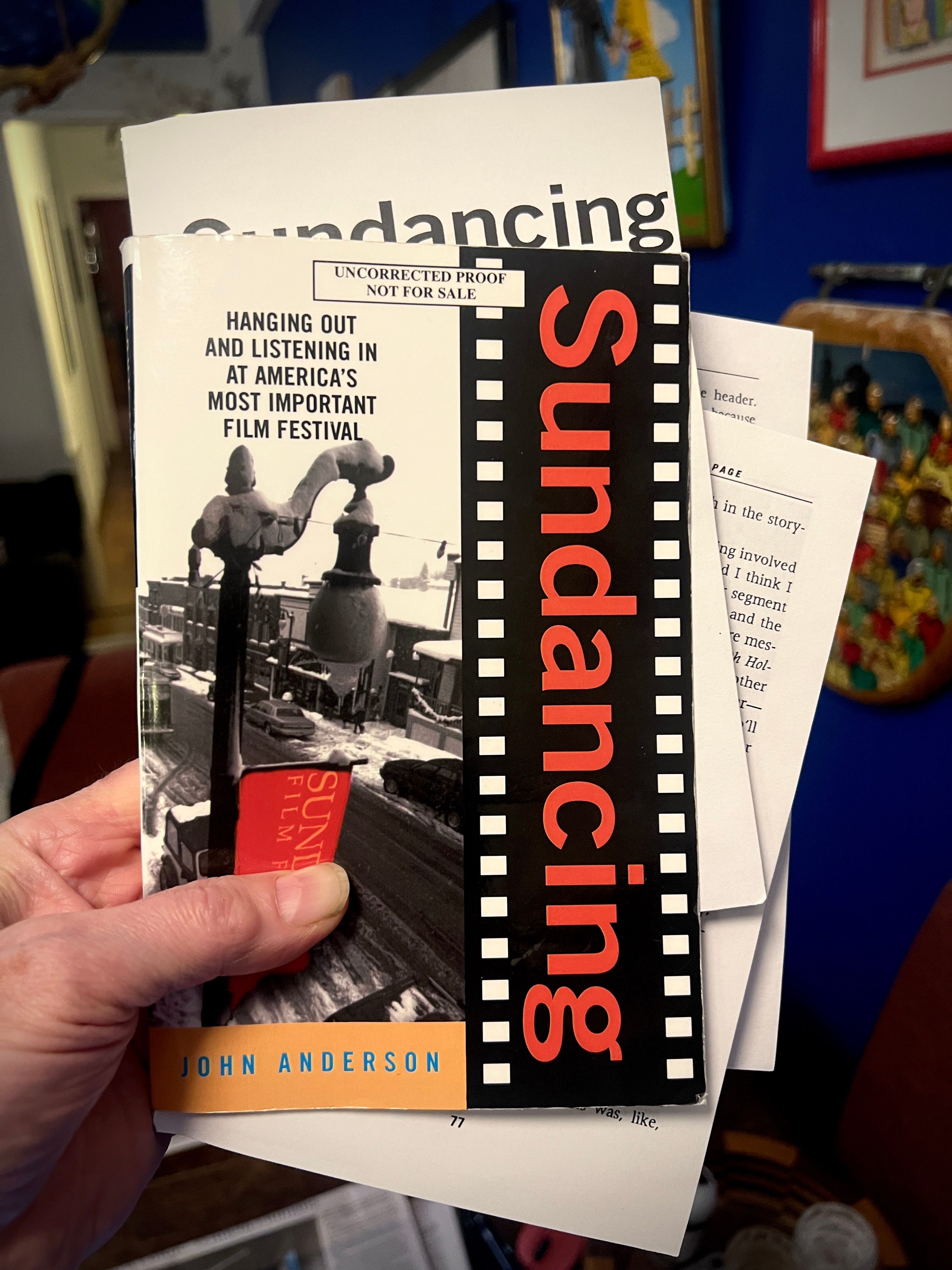
I wound up doing three interviews with John for the book, in all - two during different stages of the festival, and a final wrap up a few weeks afterwards. It’s interesting to see my eager hopefulness at the beginning, the giddy exhaustion I was starting to feel midway through, and the decidedly mixed feelings I came away with.
I’ve cherry-picked some choice quotes, keeping in mind the contrast between the giddy turn-of-the-century distribution possibilities vs. the gloomy state of distribution today. A few anachronisms aside (Miramax, the need to exhibit a doc shot on video on 16mm film), I think much of what I had to say still rings true. And they’re observations and perspectives I’d share with any filmmaker fortunate enough to have a film showing at Sundance this month. Especially a documentary filmmaker.
If that’s you, good luck and God bless. I hope you — or anyone who has ever dreamed about what it’s like to be in your position — find it illuminating. And not too scary.
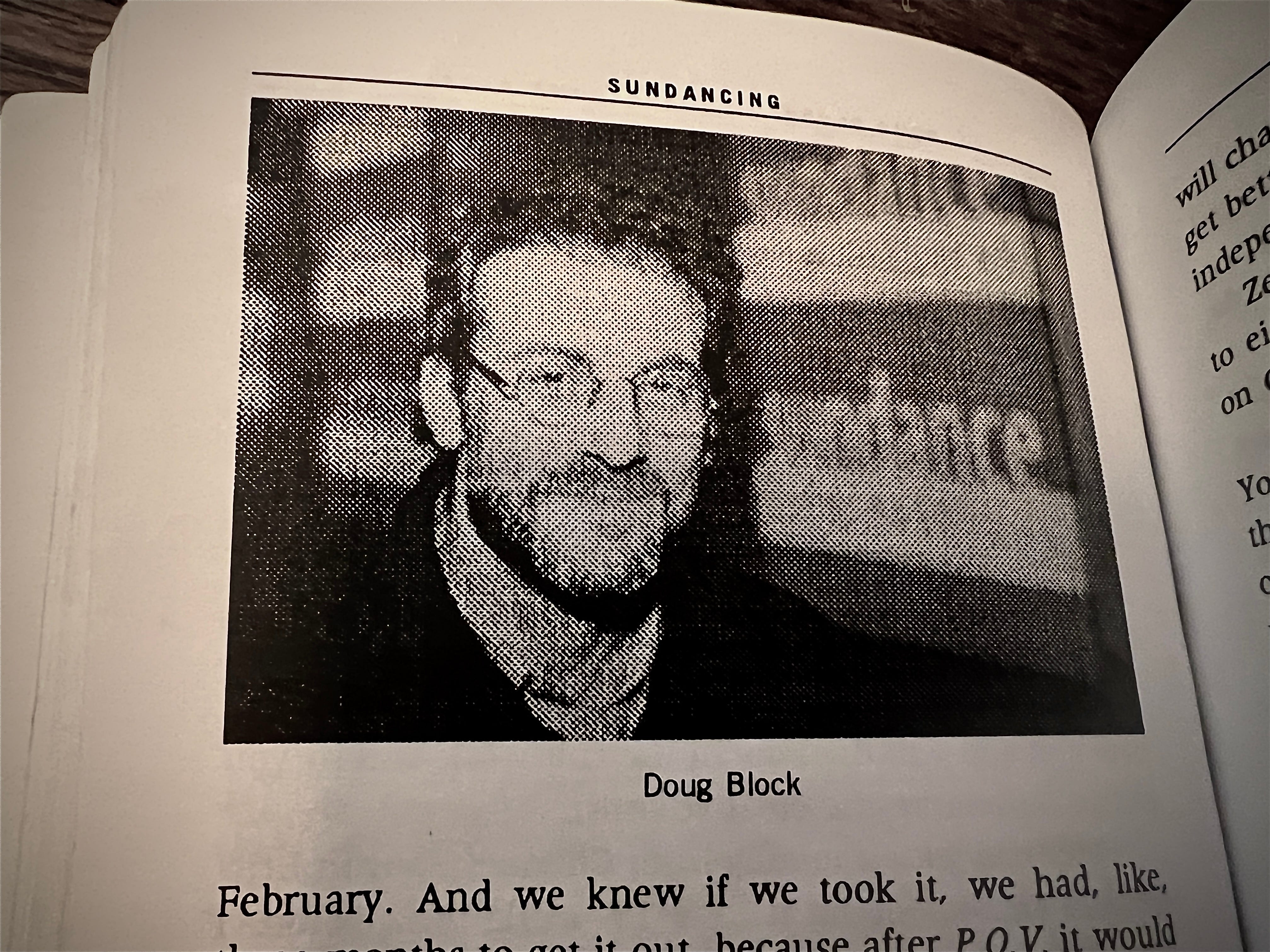
First Interview: The day before my world premiere screening
One thing about Sundance is everybody gets a publicist. You almost can’t compete without one. You won’t even be in the mix. All we ask for as a filmmaker, at least all I ask for, is to be considered. To be put out there properly so people can make up their own minds. In our case, we’re also trying to intrigue the press about Home Page as an interactive project. An example of experimentation and play and convergence and the direction movies will be going.
The notion of celebrity, while it’s inspired a lot of people to make films, it brings and awful lot of people to make films for the wrong reasons. The media just totally feeds into it, and Sundance is a big part of that. I don’t think it’s the fault of the organization at all; they run a good festival. But ever since “sex, lies and videotape” there’s been that mania — and it’s not just the Hollywood types; it’s the media — of finding a star, of looking for the Cinderella story.
I wouldn’t mind being well paid for it; that would be really nice after years of not even drawing a salary. But I’ve never worked on something before that has the potential to hit an audience as widely as this one does. Or to be as exciting to people who go to Sundance looking to discover something. The reaction could run the whole gamut, so I’ll be really curious.
You go down the list of other documentaries showing here and I’m sure most of them are really well-made, compelling films that are going to sell out and do well and they’ll have their Sundance day in the sun, which is great. Because you have very few other rewards as a documentary filmmaker — it goes out and evaporates into the cultural mist.
It’s really important to go to Sundance clear on what you want from it, not getting seduced by the pipe dream of Harvey Weinstein buying you a Stoli at 2 in the morning and throwing a three-picture deal in your lap and saying, “Sign this in an hour or we’re not interested.”
The main thing about Sundance is it’s a validation of you as a filmmaker. Maybe all the validation you really need. You know when people say that being nominated for an Oscar is the big thing, that it’s not winning the award. There’s a lot of truth to that. You just want to be taken seriously as an artist, as a filmmaker, and all your friends and family know what Sundance is, they’ve all heard of it. If you get in, it’s like being nominated for your Oscar.
I want to treat it like it’s the last festival I’m ever going to go to. And do it without the idea that I fail somehow if I don’t win a prize.
Second Interview - Mid-festival
Everybody from the film who worked on it came. What we did was rent a condo, a two-bedroom condo with two pullout sofa beds, a fireplace, an outdoor jacuzzi. People scattered on the floor in sleeping bags. We were so busy, nobody had eaten. One night we had dinner after a screening at our condo, a bottle of tequila; six of us went out to the hot tub, peeled off our clothes, drank tequila, jumped in the snow banks and did snow angels, went back in the hot tub — had a great time. Got no sleep. You don’t go to Sundance to sleep.
To meet these other filmmakers — we all work in isolation for years and years and years — they live and die with their films. When we talk about distribution, the talk among ourselves is very realistic. We know Miramax isn’t beating down our door; we know even Artisan isn’t beating down our door. Which doesn’t mean they won’t.
We’re doing a lot of postcarding. I decided the second day that the way to build word of mouth among audiences was to go to documentary screenings where people are waiting on long lines — these are the audiences — and I came with a thousand Home Page postcards. I walk from one end of the line to the other. Tell them I’m the filmmaker, tell them about the film, and tell them, “Come see the film, interact withthe filmmaker and the people in it. Become part of this big interactive film/web experiment.” So I hope it will build to something by the end of the week.”
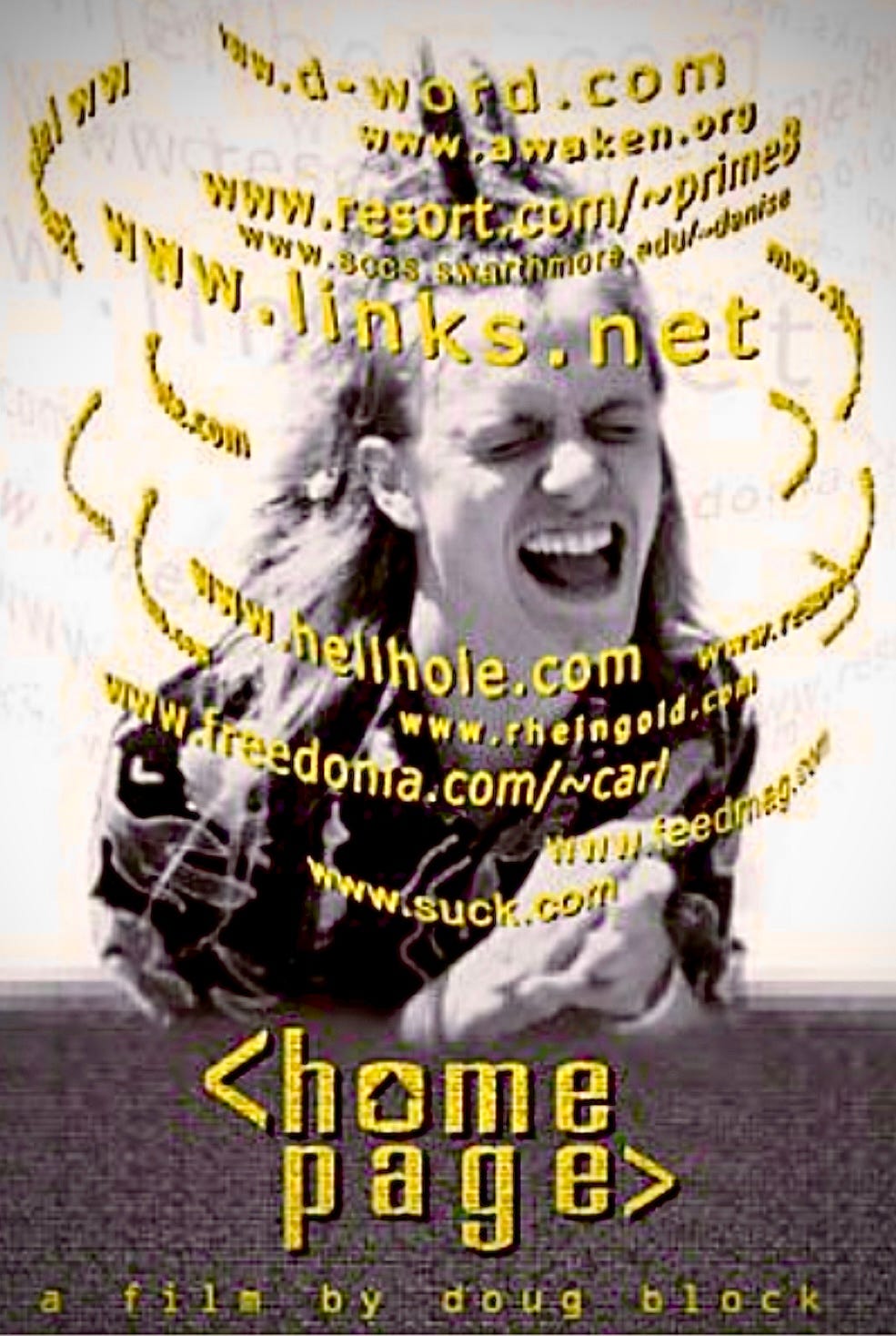
Final Interview - Two weeks after the festival
You’ve never seen such long and gloomy faces as on the plane ride home with the filmmakers who didn’t win prizes. But as someone who’s gone home having won prizes, it ain’t that great, either. You know you always find something to complain about — “Yeah, we won a prize, but no distributors came to our screenings.”
We weren’t one of the hot films there, but it became clear that we were really well respected and liked, and that people were talking about us. So that was really gratifying. It didn’t stop me from being frustrated to no end that we couldn’t build a bigger buzz around the film. Virtually every screening was full. But the business part was hard.
How many good films come out of here? With the documentaries, there’s a much broader range of good, really solid, well-done filmmaking. If you had to come up with fifty really good documentaries in a year, you probably could. Not all of them great, but your fiftieth documentary would still be pretty solid. Your fiftieth fictional film — American indie, low budget fictional film — is going to be dreadful. Your twenty-fifth is going to be dreadful. Coming up with sixteen for the competition, you’re going to have some dreadful ones. The programmers look at hundreds and hundreds of them. It tells you how hard it is to make a really great fictional film.
You always hope you’re catching lightening in a bottle. That’s basically what you’re going out to Sundance for. You try to keep your expectations low — particularly if you’re a documentary filmmaker. But then you get out there and you’re in this environment that plays mind games on you. You just can’t be unaffected by what’s going on — especially the heat and attention on other films.
Sundance? It was the best of times and the worst of times — 90 percent was the best of times. It was exciting, frantic; you’ll never get as much attention. We had almost constant interviews, Q and As, screenings, parties, drink fests. I hardly had time to make calls, no time to eat. No time to sleep. I didn’t do a lot of big parties. My idea of a good time is a few people and a few drinks; I don’t want to go to these blowouts and meet a lot of people from LA. And they certainly don’t want to meet me!
I’ve come to the conclusion that the theatrical experience is very overrated — particularly when you have a 16mm film on your hands. 16mm is on its deathbed and I want to be its Kervorkian. It’s a nightmare. In two or three years it’s going to be gone. Digital is going to turn the industry around. It’s really exciting when you think what it can do for the future of filmmaking.
These were just a fraction of the comments I made in the book, and I’ve left out a few choice ones where I was embarrassed by my candor (one where I ripped another filmmaker by name is high up in my Hall of Shame). John was a clever interviewer, understood the indie film industry thoroughly and was smart to interview me over breakfasts when I was exhausted and over caffienated.
Looking back at what I did include, a few things stand out.
Sundance is a peak experience for a filmmaker.
At the same time, the mind fuck it can play on you if you’re not experienced, and in some ways hardened. After working on your film for years in relative isolation, you’re suddenly in a very competitive environment, with the eyes of the industry and fellow colleagues upon you. You see other films and filmmakers getting all the buzz or landing a big deal, and it sets you up for disappointment.
My comment about validation. In a field where so much is out of your control - funding, distribution, the judgement of critics and audiences - validation has to come from within. And nothing makes you feel more validated as a filmmaker and artist than having your film picked for the Sundance competition for the first time.
Getting to share the Sundance experience with your team. They’ll all want to be there with you, and you’ll never appreciate them more, or have the opportunity to express your appreciation more.
My prediction about digital. Bingo!
RIP 16mm, I send you flowers.
What a good read!
Thanks for taking us into your space capsule. While there, I found memories of the years I had my very own Sundance experiences.
I won’t mention getting sick from the altitude, or the parties I dared to crash, although I’d add both to your invisible list.
Brava, Doug! Brava Newbies!