
Most Docs Will (Likely) Not Get Seen!
A well-timed guest post by international sales agent extraordinaire Jan Rofekamp


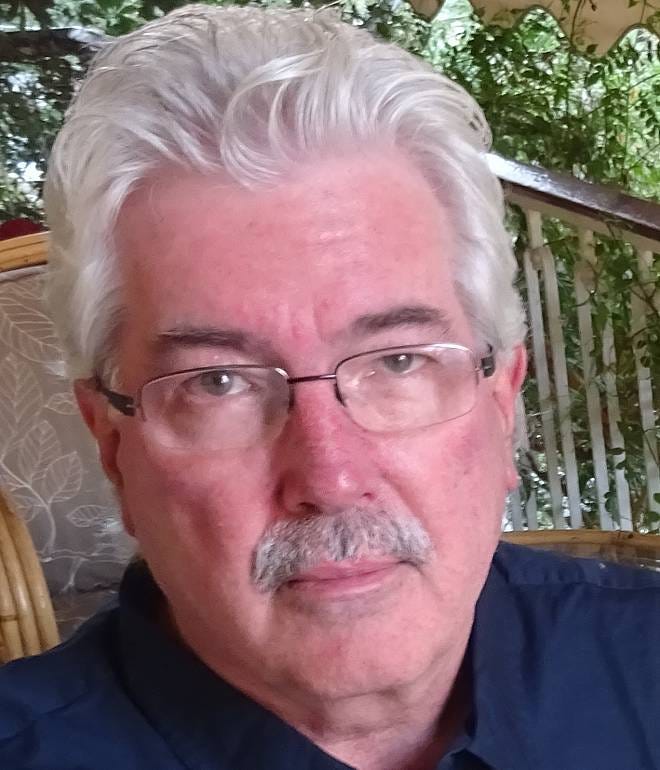
I’ve been meaning to host occasional guest posts ever since I started my Substack. Well, here I am, almost a year into it, and this is the first one. I guess I figured the universe would conspire and an opportunity would present itself when the time was right. And (along with the Knicks becoming world champions — am I still dreaming?) the universe just did me a solid.
Shortly after I published my Thoughts on the Future of the Feature Documentary here on Substack last week, I received an email from my friend and former sales agent (and documentary legend!) Jan Rofekamp. He’s still active as an international strategy consultant from his home in Athens, and continues to have his finger firmly planted on the pulse of the doc industry. So it was an honor (and an easy yes!) when he asked if he could share my post with a long list of industry colleagues he remains in constant touch with.
Jan had attached an essay he’d written for them late last year with his own thoughts and concerns about the state of the feature doc. “The majority of people have their heads deep in the sand,” he wrote by way of explanation. “And if they do not understand why and how the doc world is changing they are fucked.”
It felt like an extension of what I’d written, only backed by considerably more firsthand experience and skin in the game. So I immediately asked if I could publish his essay as a guest post, as many of my Substack readers are documentary professionals and need to hear what he has to say. Jan generously agreed, and lightly tweaked and updated it. Be warned that it’s a lengthy read but it’s an important one, and well worth your time.
Most Docs Will (Likely) Not Get Seen!
by Jan Rofekamp
June, 2026 (updated)
Two recent quotes:
As a documentary producer told me recently, “The most important thing in the independent nonfiction world right now is not developing new directors. It’s developing new distribution mechanisms.”
“Anyone can make a film, but making a film that others want to watch and will sell is the hard part!”
During a recent visit to a large media-market, I told a colleague that the AI and Streaming frenzy of today is like the DVD and Video frenzy in the 90’s. Hundreds of DVD and video-rights buyers popped up. These were indeed good days. And they paid also, but then he told me, the DVD and Video was in those days an ADDITION to the existing markets....today the AI and Streaming tsunami is TOTAL TAKE-OVER, killing the other markets.
Today’s doc eco system seems more active than ever but finding sales or any form of distribution for a doc has become very hard and for many docs, and sometimes literally impossible. Apart from monetary issues, on top of this, caused by the increasing right-wing take-over everywhere, the ways to get progressive messages (docs) to a broader audience are in clear danger today.
For decades, traditional linear broadcast was a good road to a broader audience, but the presence of the broadcasters at doc pitch events has become a shadow of what it once was, sadly. This means that the progressive doc industry must work hard to become less dependent on the traditional distribution channels that are fading away.
I have been active in international documentary film sales and marketing since the early 80’s. In those days there were barely any doc sales agents and barely any doc festivals, and certainly no doc training events, apart from the traditional film schools, but they were and still are mainly interested in fiction.
Today there are hundreds and hundreds of doc (or mixed) festivals: A-list, B-list, Z-list, thematic (Human Rights, Arts, Jewish, Ecology) you name it. And there are worldwide also hundreds of doc industry events, training courses, workshops, masterclasses (many of them well subsidized), also hundreds of consultants, doc teachers. There is also today a long list of active doc sales agents.
If, today, someone would want to become a documentary filmmaker there are a lot of inroads, seminars to attend, texts to read. There is indeed a lot of help out there.
These developments have incredibly increased the awareness around and the reputation of the documentary genre over the last 15 to 20 years. The festivals, training and pitching events have created and brought together a huge international community of filmmakers. There are active associations, print and online magazines and besides the traditional national film funds, there are more non-governmental (often ideologically motivated) film funds than ever.
Today’s A-list of doc festivals launch every year 100’s of new docs and many love world premieres, (shows good for their funders!) or even require this for the main competitions.
One look at the delegate lists of doc events like IDFA, Sunny Side or CPH Dox shows huge, impressive lists of players in the different fields. BUT....the long delegate lists ALSO show an enormous increase in numbers of directors and producers, a lot of them first or second timers with little experience. It is not uncommon to see on a delegate list 400 directors and producers and....but then a meager 40 ‘decision makers’ The recent Sunny Side list counts no less than 527 French delegates, most of them doc producers!
One can ask the question, does this landscape have a place for all of these films? One sees on the delegate lists over the years an ever smaller and smaller number of participating ‘decision makers’. The broadcasters are more and more interested in ‘domestic stories’ from their own soil and therefore becoming less international players. Most of them who used to be listening to pitches, just don’t come anymore. The sales agents who need broadcast sales to live, become more and more ‘picky’, as broadcast deals are the ONLY non-speculative deal on the table, the rest is wait and see who comes or clicks. The DVD is gone and replaced by increasing numbers of digital distributors/aggregators/streamers with still a very mixed revenue result and in most cases: no money upfront. Whereas in the fiction world ‘advances’ or MG’s are still common, in the doc world they are not.
Because of the huge numbers of docs produced these days, it is unavoidable that there is a lot of ‘more of the same’...and that does not help either. How different are all these films on the Ukraine or the Palestine issue?
If you are an independent doc filmmaker, it has become a cruel reality that chances are that you film will NOT get seen by audiences further than the audiences at some (often small and unimportant) festivals, your film will NOT find a sales agent or NOT get any form of decent distribution or broadcast. Most docs will simply NOT get attention and NOT get anywhere in the market.
There are and will be increasingly large numbers of filmmakers who after months of trying are asking themselves: I am not getting anywhere... what now? The Doc-Pitch events carefully avoid doing and publicizing statistics after the event: “so you pitched, what happened?” The doc training and pitch events don’t hand out statistics about success: which pitch was successful and how? One reads: “35 great projects were successfully pitched”... but we will never really know how many of these films scored immediate success.
(Docs on domestic stories sometimes work well in the country of production, most of the time with a local broadcasters(s) involved and sometimes get good distribution —even theatrical — but will not travel beyond that country’s borders. There are some great examples of very successful docs that scored very high in their country, but nothing happened abroad.)
Today as consultant I get a lot of queries about distribution options and, more than ever, I barely have answers. Sales agents tell me they now hesitate to spend the time and money to go to the major doc events, they don’t need to see 100’s of films and talk to 100’s of filmmakers. New projects: they go online pick out 3 or 4 titles that interest them and that’s it. Broadcast buyers: same story, even though they get invited, hotel and travel paid...which is not the case for the sales agents, who carefully have to weigh expenses. Each sales agent either needs to have at least 4 or 5 docs that are big sellers each year, or find more sellable conventional docs (wildlife, science, discovery, history) The result is that docs that really sell are either about celebrities or are strongly thematic: history, crime, science, sport, nature and wildlife etc.
Here is the situation: For almost all docs ‘theatrical’ has a become almost impossible hurdle because of the high costs and risks involved (except sometimes in the country of production). Broadcast is buying only a tiny fraction of the docs that are launched on the market every year, and the docs that our ‘doc world’ produces almost never get any prime time, hence the low fees. The options of getting a feature length doc on TV have become very slim. The beautiful DVD format does not exist anymore. The major streamers buy a tiny fraction (mainly about crime, sports and celebrities).
For the many other streamers (smaller, local, national) ‘buying’ is a big word, most of these smaller streamers want you to give them your film on a (speculative!) revenue share deal. Many of them even want you to advance the upload costs!
The sales agents, under tremendous pressure to find films that sell and that make the money to keep their company running, have become very selective about what they take on.
So, there you are. You have made a decent documentary, but you don’t get into Sundance or Berlin or any of the other A-list fests....all the sales agents you wrote to said no (also because you did not get into the main fests) and you have no idea what to do...where to go, where to find possibilities to show your film. Here we come back to the title of this text: MOST FILMS WILL NOT GET SEEN!
WHAT THEN?
What was impossible 20 years ago, is today possible. Filmmakers MUST get taught about forms of self-distribution. Doc festival industry sections, workshops, training courses MUST take time to teach filmmakers this. There are lots of mentors and tutors but, knowing the circuit, only very few of them teach on distribution issues.
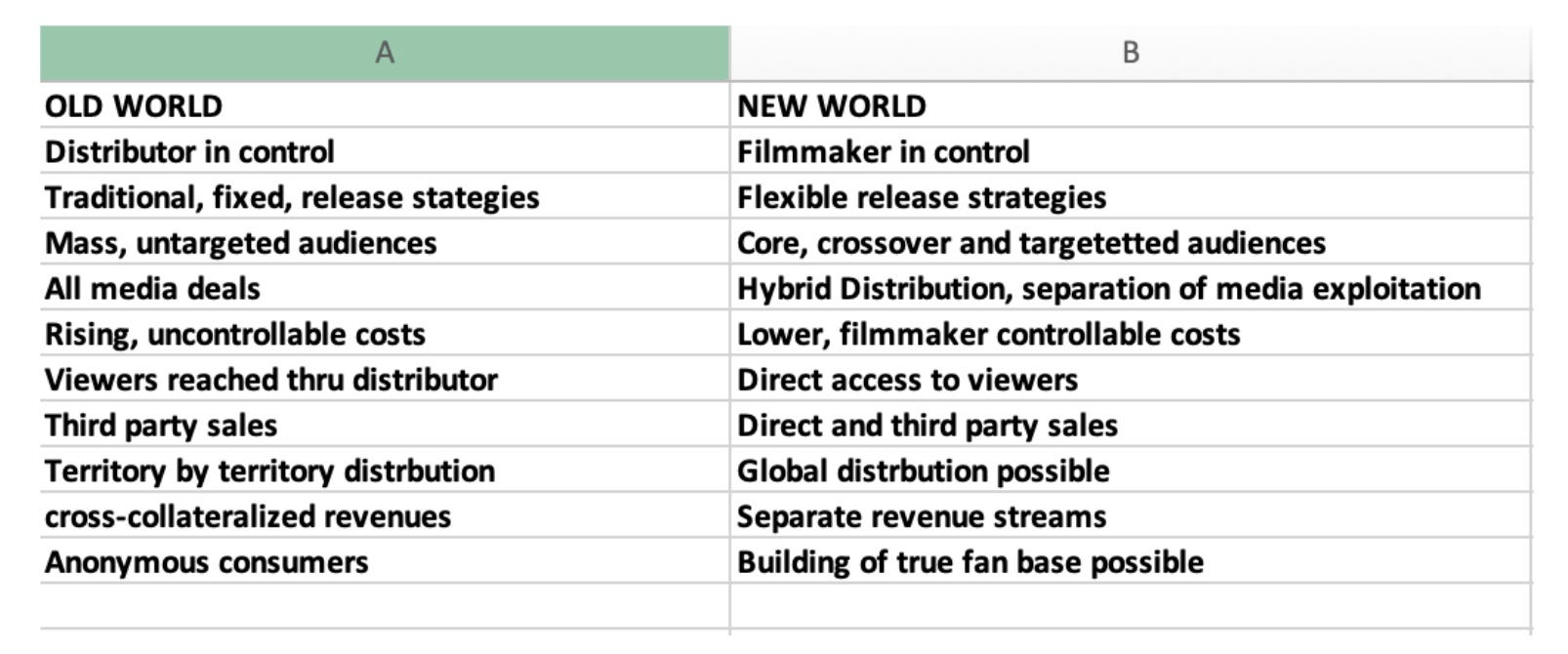
I have sometimes the impression that the doc training world is still operating primarily in the Old World ( see Peter Broderick’s Old World vs New World chart below). Unthinkable 20 years ago, but today with potentially massive audiences organized online, finding audiences IS possible, but one has to be aware of the time and money this will cost.
Check out Peter Broderick’s Distribution Bulletin #48
REVOLUTIONARY DISTRIBUTION
“THE WISDOM OF TRAUMA”
- An Exclusive Special Report
The key to self-distribution success is if, around the theme of your film, there is an identifiable, organized and approachable online community that you can approach and involve. Case studies on these issues can teach you how to approach them and what to ask. If 100,000 organized antique car lovers each wire you 15 dollars for a future link of your film (a copy to own)...that is 1.5 million dollars! There is no traditional distribution world out there that can compete with this. The above case study is an excellent example.
But if your film is a tiny, micro-story with no clear storyline, or about yourself or the story of your grandparents, with no specific target group identified....it obviously becomes a little more complicated.
To give you an idea about the growth and power of YouTube, here are some mind-boggling statistics. But filmmakers need to know/ learn how to monetize this. That is the massive task in front of us.
Also, look for Digital Distribution Consultants (as there are a few now) who can help you strategize. One such person is Wendy Bernfeld — take a look at her Linkedin.
And here below is a little chart that shows you the difference between then and now.
Jan Rofekamp
Films Transit International
www.filmstransit.com
Mobile when in Europe: + 31 6 5392 6555
From outside Europe (call via WhatsApp): + 31 6 5392 6555
 | A guest post by
|
Thank you for sharing this insightful article Doug. Jan tells it like it is!
Thanks for sharing this Doug, and thanks for writing it Jan, incredibly valuable insight ^Lorna