
Getting Personal with My Readers
A challenging personal situation has me pivoting in an exciting new direction.

Next week will mark exactly one year since I started my Substack newsletter, and this is the most difficult post I’ve written yet by far. Or at least the one I’ve avoided writing for the longest.
When you make personal documentaries, there’s always a fraught work-life balance to maintain. On the one hand, if you manage to tell it well, your family story has the potential to resonate powerfully with viewers throughout the world. On the other hand, it’s nice not to fuck up the most important relationships in your life.
I don’t see this tension being any less precarious when writing for Substack, especially with one I’ve chosen to call Getting Personal. I walk the tightrope.
I’m writing this towards the end of a ten-day vacation to Montreal, Quebec and Maine with Marjorie and our 7-month pregnant daughter Lucy. My step-son Josh, who’s been in my life since he was a 6-year old squirt, managed to join us for a few days before a trip to the UK with his own nuclear family. It was a poignant gathering, as it’s likely the last time just the four of us will ever be alone together like this.
It was particularly sweet to see Josh and Lucy interact. He’s 14 years older, but they’ve always been remarkably close.


Both of them made sure to carve out time alone with me to ask how Marj is doing, and to reiterate their support for me. I told them she’s mostly fine, you’d think nothing is wrong most of the time. It’s mainly apparent in terms of her memory. She might ask me something she already asked just a few hours before. She increasingly forgets where she puts things down, like her phone or iPad. She’s missed several appointments because she forgot to check her calendar. At times this makes her anxious, but more often she treats it with good humor.
At one point they received a first-hand illustration of her condition. We stopped for lunch on our way to Quebec City and had an unusually long wait for our order to come. Josh took the opportunity to tell an anecdote — at my expense, which he delighted in.
When he was around 11, we stopped off from a long car ride for lunch at a Friendly’s Restaurant. Apparently I complained to the waitress that my burger was way too small, and it took forever to get a replacement. In my impatience, he claimed, I took a plastic ketchup bottle and squeezed out “Where’s the beef?” on my empty plate. Everyone thought that was hilarious.1
The next day Josh alluded to the story and Marj was baffled. So he repeated it verbatim, and she responded with a hearty laugh. I noticed Lucy and Josh exchanging looks. I reassured them there was an upside. Now when I tell a joke she finds funny I can go back and repeat it as if it were new.
The other week Marj and I were on an Amtrak heading to Washington, DC for the DC/DOX Film Festival, where I was to give a talk with Nina Seavey titled R/Evolution: New Paths for Documentary Storytelling. For the first time I would explain how Betty & Henri (& Me), a film I’ve obsessed over for almost a decade (largely because I haven’t been able to raise a dime through traditional funding means) has transformed into something else. Something different and exciting, I think, but no longer a feature documentary. At least not for the foreseeable future.
I was hoping to explain why it’s transformed, as well, so I asked Marj if the time was finally right to publicly mention the A-word. She said yes, but asked me not to do it at the festival. It might make people feel too awkward around her, and she wanted to have a good time.
Marj’s mother suffered from Alzheimer’s for the last ten years of her life, and it’s always filled her with dread that genetics might win out. Three years ago her deepest fear was realized when she received a diagnosis of mild cognitive impairment, a precursor to Alzheimer’s.
She’s done everything she possibly can to stave it off — including enduring 18 months of bi-weekly Leqembi injections — and she continued to teach effectively up until her retirement last December. We both noticed the marked increase in memory issues, however, which we tried to not freak out over. And the aftermath of retirement was rougher than expected — our usual routine was thrown off, which resulted in increased stress. Good days and bad days turned into good hours and bad hours.
One day Marj confessed that even if I got full funding for my film tomorrow, the thought filled her with anxiety. She knows how all-consuming editing is for me, and needs me now to be far more available.
I’m hardly a flawless person, believe me. But when all those years ago I vowed to be there for better or for worse, in sickness or in health, well, this is what I signed up for. And I’d do it again, without a moment’s hesitation.
Suddenly the feature film I’d envisioned in my mind for so long was no longer an option. And so I pivoted.
During my talk I merely said that my wife recently retired after 40 years as a professor of law, and now wants to do a lot of traveling. And that our daughter Lucy, frozen in time at 18 in my personal doc The Kids Grow Up, is now 36, pregnant with her first child, and eager for help with child care when the time comes.
But I had a more film-centric point to make to the doc makers in the audience. At heart we’re storytellers, and we need to be nimble in adjusting to circumstances. At a time when funding and especially distribution opportunities have cratered in the film industry, we can no longer afford to be prisoners of the 90-minute format. We need to consider other alternatives. We should actively be looking for outside-the-box ways and means to tell our documentary stories.
Necessity is the mother of invention.
I’ve thought about this time-honored proverb long and hard over the past year, and here’s where I’ve landed.
From the beginning, I’ve felt that Substack is totally underutilized as a multimedia platform. I’ve been weaving in still images and embedded video into my posts, and Substack does it elegantly.
What if I were to tell the story of Betty and Henri, my discovery of their love letter and my attempt to return the long-lost letter to its recipient Betty, in serialized form on my Substack? How might that work?
I suddenly saw all these possibilities.
It could be more interactive.
I could solicit my readers help in tracking down Betty and returning her missing love letter to her, or her family.
I could delve deeper into the fascinating characters I came across in my search — the psychic, the handwriting expert, the bounty hunter, my friend the rabbi, among so many others.
Each chapter could be a short story in and of itself
Much less need to fundraise.
The need for traditional film distribution? Ha!
I could travel and write from anywhere.
My other film work — producing, consulting, The D-Word — is mostly remote, so it’s not impacted. Carry on, mate.
I could be there for Marj whenever needed.
It’s a different and exciting challenge for me.
It’s fun.
It’s creative.
It has monetizing potential. After creating a proof of concept on Substack, I could pitch it to more prestigious platforms with larger subscriber bases.
I could sell the movie rights to A24 for gobs of money (and of course have Brad Pitt play me).
And maybe — who knows? — it could still end up being a feature doc! More improbable things have happened.2
I have to admit, I’m still trying to figure out how to describe this newfangled concept of mine.
Part book, part film, told through serialized chapters.
A serialized story that merges memoir, investigation, and documentary filmmaking into a single multimedia experience.
A serialized documentary memoir that unfolds through both written narrative and embedded film scenes.
Now this is where you, my loyal readers, might come into play. I envision this as an interactive process where I utilize your feedback and help along the way. Help me solve the mystery. Help me to find Betty. Help me return the letter to her (or her heirs). Help me incorporate that into the story in a way I couldn’t possibly do if it were a feature documentary. Hey, become part of the story yourself.
I don’t plan to dwell too much on Marj’s condition here moving forward. The mission of my Substack is primarily to help filmmakers navigate the challenging path of making personal documentaries and telling their first-person stories. I’m more comfortable supporting your efforts than asking you to support mine. But you never know. Sometimes life takes you where you never planned to go.
That said, if any of you fine folks have experience in dealing with loved ones with dementia, I’d appreciate any tips that can help me navigate my way (feel free to DM or email me). I only witnessed Marj’s mom’s condition from afar, I have no experience in dealing directly with such matters. I have Josh and Lucy’s full support, but they have no experience with it, either.
When Lucy was a teen and occasionally challenged my parental authority, I would tell her my job description was to keep her alive until she was 18. To my surprise, more often than not it actually worked.
It’s terrifying to think there might come a time when Marj will look at me and wonder who I am. If so, my new job description is to say my name, point to our wedding rings, and tell her I married way above my station and there’s no getting rid of me.
Or perhaps I’ll pull up this recent photo from Quebec where we stopped off at a waterfall taller than Niagra Falls.
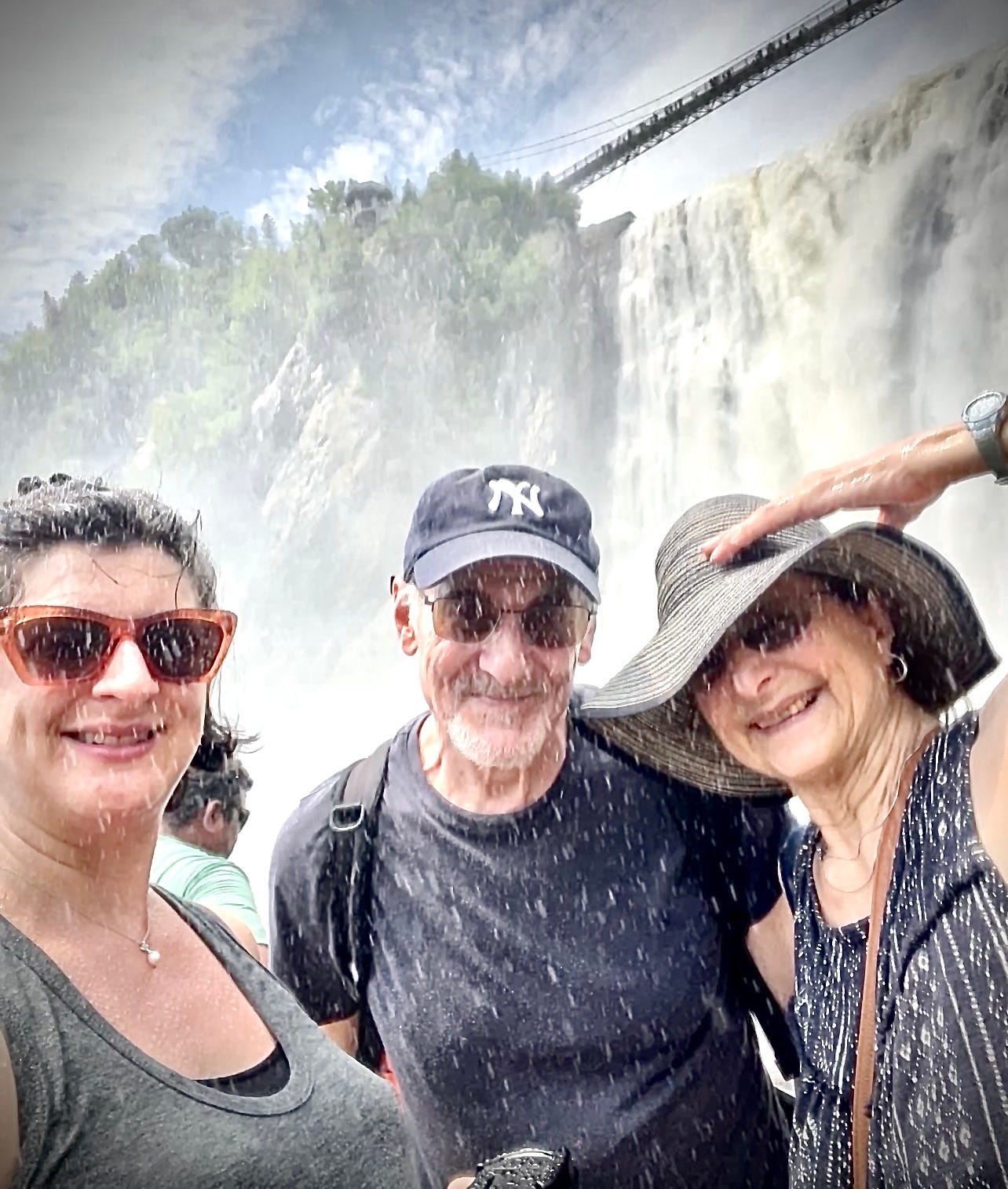
It was a hot and humid day, and we ended our visit so close to where the water hit the ground we got thoroughly drenched by the spray. I might tell Marj that’s her daughter Lucy on the left, two months before she became a mama herself. The dashing dude in the Yankee hat… that’s me, happy to be there with his two favorite ladies in all the world. And that smiling beauty on the right… well, she’s just this gal I promised to love and cherish til, ya know, death do us part.
I can’t say I remember, but it certainly sounds like something I might do. Even today.
Like Knicks in 5!
Please know that I'm doing well, all things considered. Doug waited until he had my blessing to share my condition with all of you. If any of you want to learn more--for yourself or a loved one--about the leqembi protocol I am on to forestall the advancement of the disease, or the various resources available--the organization CaringKind for one--please don't hesitate to reach out: msilver965@gmail.com.
Doug, your post had me in tears. Your humor, your generosity to your readers and your love for your family all come through so powerfully. Having seen your movies makes me feel connected to them, so I love getting updates about how things are evolving, including your daughter's pregnancy and the difficult news about Marj's diagnosis. Your personal storytelling is already continuing here on substack, and I love your idea of using it to develop an innovative format for your love letter project. I'm totally here for it, and I especially like the idea that you won't be confined to those pesky 90 minutes that require you to leave almost everything out!!!