
Getting Personal with Judd Apatow
"The greatest gift you can give is your story."

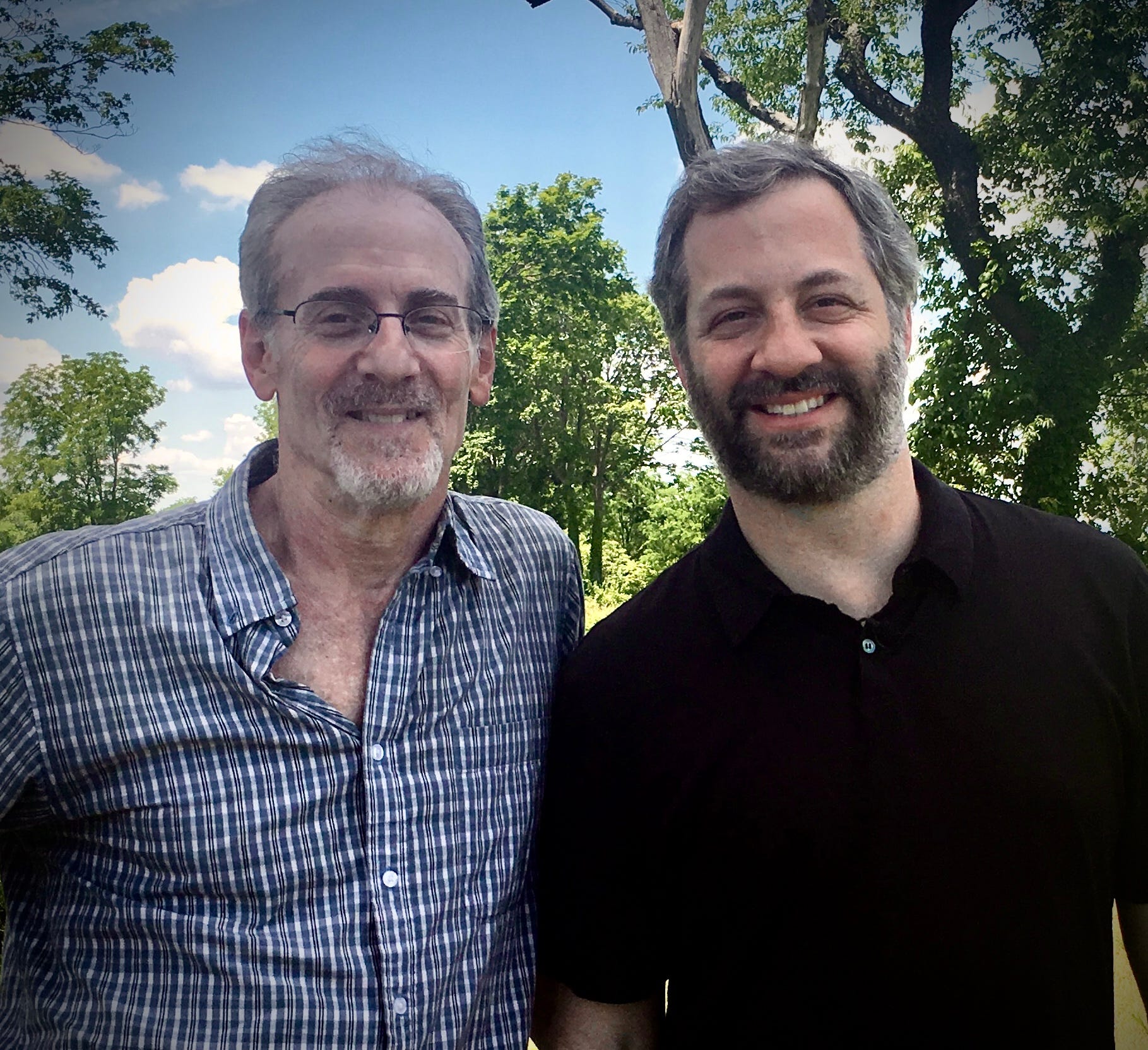
It was among the most amusing openings to an email I’ve ever received.
Doug,
I am a director and writer. I made the films Knocked Up and The Forty Year Old Virgin.
As if I don’t know who Judd Apatow was.
He explained that he’d lost his mother suddenly two weeks before, and a friend had recommended my film 51 Birch Street to help him process the complex emotions that had come up for him. He was writing to say he thought it was beautiful and moving.
It was May of 2008, well over two years since the film’s release, and I was still getting powerful, deeply personal messages from viewers on a regular basis. But not from the likes of someone whose own work I so admired.
I believe directing a comedy is harder than any other genre of movie making. And directing a comedy that successfully walks the fine tonal line between funny and heartfelt is what separates out the greats. Think Billy Wilder’s The Apartment. Francois Truffaut’s Shoot the Piano Player. Sydney Pollack’s Tootsie. Early Preston Sturges. Judd Apatow’s movies are squarely in that upper echelon company for me.
He’s also prolific as a writer, producer and executive producer for others (Superbad, Bridesmaids, Anchorman: The Legend of Ron Burgundy, Girls). Most famously, at least in our family, he was a major force behind Freaks and Geeks, one of my teen daughter Lucy’s all-time favorite tv shows.
I never impressed her professionally more than when I forwarded Judd’s email to her.
OH MY GOD!!!!!!! WOW!!!!!!! … ummm so can you be friends with him?
I wouldn’t say Judd and I became friends, exactly, but we kept in touch. I assumed he was busy juggling multiple projects, and didn’t want to overstep my bounds by asking for feedback or help with my next films. But he was always happy to watch when they were finished, and was invariably complimentary and encouraging.
He wrote something in that initial email that stayed with me. He was responding to the climactic question I asked of my mother’s best friend in 51 Birch Street — whether my late mother would have approved of me revealing extremely intimate portions of her diaries on camera.
I think her friend was right—your mom would love it. We all do want to be known. And sharing ourselves and our experiences with others is the most special gift of all.
With an economy of words, he got right to the heart of why making personal documentaries matter.
I couldn’t help noticing that his own films were becoming increasingly personal. And, like with me, often featured his family members. He was also starting to make serious inroads as a documentary filmmaker
So when I made up a list of leading personal doc filmmakers to interview for my documentary project Getting Personal, I thought, hmm, Judd would actually be a great, unexpected fit. Nice to have a big-name poobah, too.
I learned Judd would be directing an episode of the HBO comedy-drama television series Crashing in Sands Point, NY, a town over from where I grew up in Port Washington. He told me to come by the set and he’d see what he could do, then graciously gave me a half hour of his time between camera setups.1
Needless to say, he didn’t disappoint. He was funny as hell, of course. And had some sharp and candid, yet sweet, observations to share, as well.
In other words, he’s just like his movies.
TRANSCRIPT
What follows is my full interview with Judd, lightly edited for clarity and excessive “ums.”
JUDD
(I look) in the camera?
DOUG
You look right in-
JUDD
Right in. Holy shit! Errol Morris time.
DOUG
Yeah. He doesn’t view (his talent) from a tent, though.
TITLE: Getting Personal with Judd Apatow
DOUG
It’s really good talking to you because I think we both do this kind of crazy thing about trying to tell stories based on our personal experiences, and using our families as fodder for our art. So I thought it’d be really interesting to talk because we come at it from different angles. I’m curious how you’ve evolved. You’re known for your mainstream Hollywood comedies that make a ton of money, and yet your films seem to be getting more and more personal.
JUDD
Well, I started working for Gary Shandling at The Larry Sanders Show, and he was creating a show about talk shows, and about the personalities of people in show business. Nothing really happened in it, but it was very truthful, and he was someone that talked a lot about trying to get to your emotional core and to be as honest as you can. And the interesting part is, in movies and TV, every part of it could be completely made up, yet it could, at the same time, capture something that’s very honest and revealing.
DOUG
Was it something that you always wanted to do and were just waiting for your moment, or getting enough clout that you could sort of sneak that material in there?
JUDD
I didn’t ever look at it like it was something I wanted to do. I just made different movies and TV shows and slowly, as I did work that came from a more personal place, people responded more. Probably the first time I did it was during Freaks and Geeks. It was created by Paul Feig and most of it was based on his high school experience, but we all pitched ideas about things that happened to us. And one of the scenes was about Martin Starr, who played Bill, being somewhat of a latchkey kid, and he’s home alone and it’s kind of lonely. He’s eating a grilled cheese sandwich and eating chocolate cake and milk, and then he puts on the TV and he watches Gary Shandling performing stand-up comedy on The Dinah Shore Show. And he suddenly just starts laughing and he’s really really happy, and it’s oddly powerful because it’s about, you know, loneliness, and when your parents are divorced, and finding your passion, and it’s all done through this great song by The Who. And that was something I was very proud of. And after I finished it Jake Kasdan, who was one of our producers, said that’s the best thing we’ve ever done, and I’ve ever done. And I thought, oh, I guess that’s how you’re supposed to do this.
DOUG
I don’t know how I phrase this so it doesn’t sound insulting but what is it about bringing your family into it that’s kind of a different—
JUDD
Well, you know, I’m surrounded by very, very talented people, and I generally just want to hang around with my family more than other people, so that’s a big part of it. And luckily they’re very charismatic and fun to watch and really talented. My wife is a brilliant actress, so we’re always looking for ways to collaborate.
DOUG
Particularly with This is 40, to have your daughters— well, I know they were in earlier films of yours, but it can be construed that this is based on your real life.
JUDD
I feel like any time anyone’s writing there’s some element of truth in it, and then you fictionalize it. And my kids at the time would fight like cats and dogs. And so if I sat them down and said, hey, debate what’s appropriate for television. I knew that they would be really funny. And I knew my daughter was very upset that we didn’t understand how she felt about technology, and we wanted her to be comfortable in boredom, and to be able to sit in silence, and that she has to use her imagination and not just be looking at something all the time. And that if we did an improvisation she would really express very clearly how she felt, and it would be interesting and funny.
DOUG
Did you feel an undue pressure to be protective of your family, being as there’s a lot of money hanging on their performance? Was it an added pressure on you?
JUDD
Well, I think with every movie you just want it to do well. Because when you make movies and they have sizable budgets you think, oh, I hope this goes well because if it doesn’t go well we just may never be allowed to make one again. So that’s like the biggest pressure we all face. And with anyone I work with I want them to look great. I want them to do their best work. And certainly you know when you’re working with the people you care about the most you’re you’re trying very hard to make sure that the work is very very strong.
DOUG
Looking back on it now from a four-year distance from the release of This is 40, was there any negative or unexpected impact it had on on your family, or on your daughters?
JUDD
You know, the great thing about when we make a movie together is my kids complete lack of interest in it. My daughter Maude makes a point of never ever watching Funny People. She just won’t watch it. And now it’s like a family joke and I’ll say, you know, that’s really an important movie to me. It’s about comedy and a lot of personal ideas, and she just won’t watch it. And every time she goes to watch a movie I’ll say, why don’t you watch Funny People? So she’ll say, hey, I’m going to go watch Argo. And I’ll say, you know, Funny People is already downloaded on iTunes. Yeah, I’m going to watch Argo. So It hink the thing that’s made it all okay is the fact that they just don’t care at all. And I also don’t think that their friends watch the movies I make. So this lack of interest saved them from any embarrassment.
DOUG
You mean, with all the dick jokes and everything?
JUDD
You would think that my kids and their friends would think that I’m the cool dad, but the exact opposite is true. They just don’t care at all. There’s zero respect as a result of me being in comedy or the movie business. Zero interest. There’s no kid walking in the house being like, hi Mr. Apatow, how’s it going? I mean, they don’t even turn and say hello. Which is healthy, I think. That’s just the way they look at it. They would be much more excited if Meghan Trainor walked in the house or somebody like that, but not this older Jew.
DOUG
And much more useful for your purposes, too.
JUDD
Yeah, I mean, my wife and I talk about it. Like, is this a business you want to support your children going into? Is it a good job to be a writer, an actress, a director, a producer? They’ll decide whether or not they really want to as they get older, but I always think it’s just better than lifting stuff. There’s a lot of worse jobs than sitting alone in your underwear and typing on a computer. So I’m all for encouraging them to find a job that is something that they love, whatever that is. But for me, I like the hours. Or as they say in stand-up comedy, I like the hour.
DOUG
I’m interested in this whole aspect of why we tell stories about our lives. It seems like a very human need.
JUDD
Sure, I think that’s just how we process our experience, watching movies or television or documentaries. And for me I know that in each stage of life I wanted to tell a story about it. So I’ve made things about high school, and about college, at a TV show, and stand-up comedy, having a baby, being married, you know, a relationship. So in a way I must be trying to use art to think it through. Just what do I make about all of this?
DOUG
Except you have that added burden of having to, you know, make a hit.
JUDD
Yeah, that’s a different aspect of it. You’re trying to do something that’s kind of thoughtful and artistic and at the same time, you know, based on what your budget is, you’re you’re hoping to have enough people go see it that it’s commercially viable for the people who pay for it. But a lot of my favorite movies are big commercial movies. I love movies like Terms of Endearment and Fast Times at Ridgemont High and Diner. So, there is that sweet spot where you can make a really great movie that’s dramatic and funny and insightful and people want to go see it, and everyone’s not dead at the end. Those movies sometimes make a lot of money, too. But for me they’re about learning lessons and they’re about finding yourself and growing up, and that’s not inherently the most indie concept, you know. If at the very end of the movie an asteroid just killed all of them then we’d be, like, oh man, life, that’s so weird. I guess that’s the point, like you go about your life and something crazy happens. But that’s not really what I’m talking about. I’m talking about how people just try to connect and all the different obstacles there are to loving people, to connecting with other people, to growing up. And that’s the area that always interests me.
DOUG
Speaking of people telling stories about themselves, it’s just a weird time we live in where everybody is throwing up stories online. What do you make of this?
JUDD
I like documentaries more than movies. I just started making a few documentaries and I definitely am very interested in it, and I see the appeal. As a viewer, I prefer documentaries to scripted television. I like knowing it’s real. I like knowing those feelings are sincere and the pain is real, the joy is real. There’s nothing more exciting to me than a really great doc. The Devil in Daniel Johnston, is that what it was called?, I always say it wrong. It’s about music, it’s about mental health, it’s about your dreams, it’s about the struggle. I mean, what movie is better than that? And I could list 50 of them off the top of my head. So I get why people are into documentaries these days.
DOUG
What about personal documentaries. Do you particularly like them?
JUDD
I’m a big fan of personal documentaries, it’s a great genre. I like to just feel. So when something’s real, and I’m watching a documentary that’s about something simple, just a woman trying to have a baby, asking her friend for his sperm, watching him try to figure out whether or not he wants to be a part of the baby’s life or not, I mean that’s all I need. I don’t need a superhero to destroy New York to be interested and entertained. Just these very simple aspects of life are endlessly fascinating.
(Sound of plane overhead) And planes, I like planes, also.
DOUG
And planes like us.
JUDD
Exactly, yes.
(Watches plane disappear)
DOUG
So, have you done much taping with your own family?
JUDD
I’ve videotaped, but not in that way. I have video but it’s usually the happy moments. I have some video of the kids fighting and stuff, and I put this montage together when my daughter graduated high school. There was a big segment of me somewhat torturing my daughter one birthday morning when the kids were fighting, and everyone asked me to take it out, but I enjoyed it. I said, that was part of it, too. There wasn’t all this, you know, happy times at Disneyland. Every once in a while, we brawled. That’s life. That’s the case for everybody.
DOUG
And you can always threaten to put it up on Facebook.
JUDD
Exactly, exactly.
DOUG
Getting back to that for a second, though, do you feel like we live in a particularly narcissistic time? Or that technology has just made it so easy that it’s bringing out this human impulse? Like, if Facebook existed in the 1800s, you would have had a lot of that, too?
JUDD
I don’t know because I think there’s a difference between people who are doing really thoughtful personal films and people who just constantly videotape themselves and look at it or show their friends. Everyone takes pictures, but they don’t look like a Diane Arbus photograph. It doesn’t matter how many people have an iPhone, no one’s getting close to that. It’s like comedians. It doesn’t matter how many comedians there are, there could be a hundred or there could be 10,000, but there’s still probably only 20 great ones.
So yeah, it’s a mass of stuff. I always think about it in terms of when there’s so much creativity out there does no single thing have that much impact? I think that’s something that’s different in the world right now. We don’t really have All In the Family, where the whole world watches it. Or Nash, a big hit show that has way less viewers than it used to have. There’s not a common conversation happening the way there used to be when a hundred million people watched the last episode of Nash. So sometimes I think why make anything? Because the second someone watches it they’re moving on to 90 other things that week. Who really remembers any of it? And that’s enough to make me curl up in a little ball and not want to do anything. But luckily, I’ve had bills. If I didn’t have bills, if college was cheap, I’d just be napping.
DOUG
You and me both. Because I sort of go, like, why am I trying to raise half a million dollars and spend three, four years doing something when I could just put some stuff up on Facebook? Probably get more people watching it, too.
JUDD
I always think that that’s an interesting area, which is how many people do you need to watch what you do for it to be valuable? There are bands that I like, say The Replacements, and they were never Beyonce, and so is it any less valuable than the thing that everybody on earth is watching? It’s like doing a comedy show. It doesn’t matter if there’s 12 people there or you’re playing Madison Square Garden. Is it about your ego? Is it about connection? We live in times where a hit show might have 3 million viewers or 4 million viewers, but back in the old days, Roseanne had like 40 million people watching every week. So our relationship with art is much different because we’re all moving on really fast.
DOUG
Do you consider yourself an artist?
JUDD
I do. I think that I’m a creative person. I don’t look at the word art as sacred. I just think I’m trying to make things.
DOUG
You’re trying to make stuff that’s both really funny and really serious too, which is hard.
JUDD
Yeah, I’m trying to balance something, you know, I’m trying to be truthful, but also make something entertaining and funny at times. And that’s the weird thing, you know, what’s the balance? How funny should it be? Can it stay truthful as it is funny? But I also think when things are really dramatic and they’re not funny, they’re not truthful at all, because there’s no part of life where people don’t make jokes. Go to a funeral, I mean. Sometimes those are the funniest places that you’ve ever been. So, comedy is truth.
DOUG
I’m just curious, what is it you responded to in 51 Birch Street? Because that’s when you first got in touch with me.
JUDD
Yeah. What did I respond to in that film? Well, it took place on Long Island, which is where I’m from, so all of it felt very familiar to me. I mean, I related to every aspect of 51 Birch Street. Grieving when a mother dies, and then this conversation. Was mom happy? How was her life? That’s what you think about. And then when you see the dad find new love and the family wondering if he’s cheating, how long has this been going on? I think those emotions are very relatable because we’re all devoted to our parents, but we want them to be happy, too. I had step-relatives and have a stepmother, so I know all the conflicts people face about sharing their parents with people.
And this dilemma about whether or not to read someone’s journals is fascinating. And trying to accept a new person into your family. It’s a strange situation, yet completely human. Because what we should think is, I just want dad to be happy. That’s all that really matters. Can he be happy? He can, great! But we have all these other levels to it — how we feel about their relationship, how devoted we are to our mom, would she be happy if he was happy?
It’s weird knowing that your parents had to figure out how to get along. And most of us don’t want to know the details of what their emotional life was. I want to know. I want to know about my family and your family. I like knowing the deepest hidden thoughts and emotions that people have as they try to make their lives work, and their marriages work, and move on when someone dies. I find all of it fascinating. I felt honored and blessed that you shared it because most people don’t. It’s a real gift.
A long time ago, I read somewhere someone said the greatest gift you can give is your story. I had never heard that before. And I think that was the most important thing I had ever read in terms of my creativity because I always thought my story was boring or people wouldn’t care. But as soon as I tried to share aspects of my story, people were way more interested, and I made a much bigger connection with the audience.
DOUG
Thank you, that’s so kind. When you delve into your personal experiences for your movies are there times when you feel you’re going too far?
JUDD
When we make our movies it’s a collaboration. The family collaborates and ultimately it’s all fiction. But we’re talking about feelings, you know, and so we start from a place of truth and then we make up a lot of stuff. Nothing in any of the movies really happened, but we’re talking about how it feels to be in a family, to be married, to be a parent, to be a kid through comedy and drama. And it only works if you’re willing to share.
DOUG
It’s just so interesting, the differences in how we’re doing it. I wanted (originally) to be a fiction filmmaker, and it’s funny how life turns out. It’s like we’re tackling the same stuff, but our methods are different.
JUDD
Well, in fictionalized filmmaking we’re working for years to figure out how to get a moment that you get just by watching something or observing something that you may not even know happened until you start editing. But I might be up until four in the morning trying to figure out what that would be, what would elicit that emotion, what would reveal somebody in a very unique, truthful way. That’s why I like documentaries, because those moments sneak up on you. They happen all the time when you least expect it.
DOUG
One other thing we can do is film over time, like with The Kids Grow Up. And seeing my daughter literally growing up on camera.
JUDD
Yeah, absolutely
DOUG
You’re sort of doing that by having yours come back in film after film.
JUDD
Sure. I like that I’ve made movies with my kids at different ages, and in some way you’ve seen this fictionalized version of them growing up. It’s a really lazy Boyhood.
DOUG
It’s funny, our daughters being very unimpressed with what we do. The only time I actually saw my daughter impressed with me was when I got your email.
JUDD
(laughs) Oh really? Good.
DOUG
Freaks and Geeks is her all-time favorite, so I appreciate it.
JUDD
Good.
DOUG
Do you find yourself ever stuck for ideas? What do you do when you’re just...
JUDD
I’m stuck right now. I mean I haven’t had an idea for a screenplay in a couple of years. I’ve been doing several television shows and making a few documentaries, and I have to just let it come when it comes. I can’t really sit in a panic trying to think of it. One of the reasons why I directed Amy Schumer’s movie Trainwreck was because she was making this very personal movie, and I felt like I had a lot to add to it. But also I felt like I’ve told a lot of my own stories, and it would be fun to help people execute their stories.
DOUG
So what do you do to try and shake the cobwebs up?
JUDD
I don’t know, I think one of the best ways to try to come up with an idea is to not try to come up with an idea. To really clear the decks and just shut down completely, which I find hard to do. I’m much happier when I’m in process. It’s not even about, when something comes out, how people respond. My happiness comes from being in the middle of making something. But it would probably be very healthy to not be making anything for a while. Then I think things would bubble up.
DOUG
I say that, in part, because this documentary (Getting Personal) I’m doing now is coming out of having finished two really long-term projects that I’d had in mind for many years — my daughter (The Kids Grow Up) and then shooting weddings (112 Weddings). I went, holy shit, what next? And my family, do I really want to go back and mine them again? It’s part of the reason I’ve been talking to so many of my (personal doc making) colleagues who do this work, which I’m finding actually quite inspiring.
JUDD
Yeah, it takes a lot of courage to do it. I always feel like it’s a gift when somebody makes a very personal movie. I really appreciate it. And it makes me feel closer to people, and to those people, and to humanity, when people share at that deep a level. I just watched the documentary about Steve Gleason, the football player, who has ALS.2 And I just thought it was a beautiful thing that he opened up his life to us like that. It’s very moving, and it brings great love and compassion up in the viewer to share that journey with him. Yeah.
DOUG
It’s a special challenge when you’re doing it about your own life and you’re behind the camera.
JUDD
Yeah, it’s tricky. It’s tricky when you have an interest, and you want other people to want to be involved in the same way you want to make it. I’m sure it’s very complicated, especially with kids who could care less if you made a documentary about them. But I would assume down the road your daughter will be happy it exists, if she ever stops hating you, which probably won’t happen. Do you pay her therapy bills or does she have to pay them? Do you think ultimately she feels like it was a positive? A net positive or a net negative?
DOUG
I think, first and foremost, I’m just eternally grateful, because I think she understood how badly I wanted to make it and she was willing to go along. Of course, her friends all wanted to be in an HBO movie, so that was a part of it. But even when it got tough she hung in there, which is amazing.
JUDD
I think what it is is that you’re like me — you’re a hoarder, and it’s a hoarding. It’s just a fear of death. Sometimes I wish I could tape everything all day long so I always had it and could relive it. As I get older, I realize I’m digitally hoarding. It’s not unlike people who have piles of newspapers around the house. I’ll just save every article I want to read on the internet and I’ll never look at it. I have like an Insta paper with like 90,000 articles.
But I do think it’s a thing that comes up where you just don’t want to let go, and it’s almost more than the project. It’s just the idea that, oh my gosh, I can relive their childhood, I can relive my youth, I can do it all again because I have it. And that’s why I probably like your movies so much, because I go he’s a hoarder like me. He has to have all of it. So in some way you’re inflicting that upon your family. Like, let me hoard you. You’re like the pile of New York Newsdays surrounding some old lady.
DOUG
Um, never were truer words spoken. Actually, the only reason my late mother was in 51 Birch Street was because I’d done a family history interview with her. And-
JUDD
I never regret hoarding. I never regret it. Everything I’ve ever hoarded, I’m glad I have. Every once in a while someone will say, hey, do you have a tape of that? Or did you keep that piece of paper? And every time I go, yes, let’s look at it.
Hoarding is good. I want to do a show about hoarders that’s not like the show where they make them throw it out. I’d like to do a show about hoarders that just cheers them on. It says, yes, good hoarding! Keep more stuff.
DOUG
Well, I don’t need to actually look at it so much. It’s just- they’re my memories.
JUDD
Yeah, exactly. Why would you want to throw out your memories ever? And then you know the second you die your family just chucks it in a fucking dumpster and they don’t give a shit about anything that you cared about. They’re not even gonna look at it. They’re just gonna say, hey, send the truck, I’m gonna be on vacation that week. Just toss it, god damn it!
(Exits frame) Ok, I gotta go.
DOUG
Ok. Thanks, Judd.
I’m off to DC/DOX next week where I’ll be taking part in a panel conversation with my pal Nina Gilden Seavey called “R/Evolution: New Paths for Documentary Storytelling. The big news is I’ll be unveiling how my love letter film has transformed into a, well, I’ll keep you in suspense. I’ll be writing all about it here very soon.
In the meantime, please feel free to…
And, of course, share this post with everyone you know.
I had to be prepared to go on a moment’s notice. And once I started shooting I thought he’d have only a few minutes. I was amazed he gave me so much time and attention when so much else was going on around us. A testament to what a relaxed yet professional set he oversaw.
What a great conversation. I did not want it to end. Thanks.
You and Judd made a great connection, Doug. As the interview went on it got deeper and deeper.